
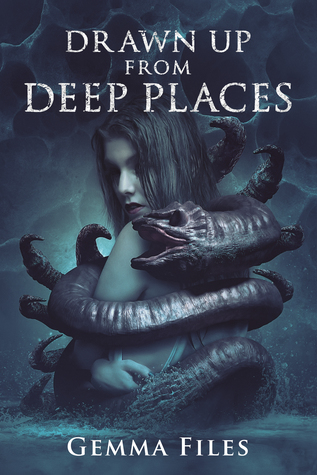
It is fascinating to assess Gemma Files’ Drawn Up from Deep Places as a collection, because the book’s construction is so uniquely connective. That is, rather than reading as an assortment of individual, isolated pieces, Drawn Up from Deep Places registers as a carefully designed, cumulative whole, comprised of two re-emerging fictional sequences woven among several standalone stories. With this text, Files displays extraordinary thoughtfulness and craft, both in conceptual and formal terms.
The collection begins with the vivid, haunting “Villa Locusta,” which situates us in an apocalyptic environment laden with mythological and religious imagery. Files further demonstrates her penchant for religious allusion with “Sown from Salt” and its companion story, “A Feast for Dust”: this duo recalls Clint Eastwood’s High Plains Drifter, injecting a somber Western narrative with Biblical and supernatural reflections.
The bulk of the collection is devoted to another ambitious, genre-crossing series of interconnected tales. These pieces (“Trap-Weed,” “Two Captains,” the title story, and the final novelette, “The Salt Wedding”) revolve around a toxic, queer, and (sometimes dangerously) magic pirate romance aboard a ship named the Bitch of Hell.
There is also a queer horror-Western populated with demonic zombies (“Satan’s Jewel Crown”), a dark, culturally-specific love story with supernatural threads (“Hell Friend”), and an assembly of screenplay-formatted tableaus set around Jack the Ripper (“Jack-Knife,” definitely my favorite). With “Jack-Knife,” Files draws adeptly on her cinephilia and film criticism background, designing a narrative that reads both thrillingly as prose fiction and convincingly as visual text.
Drawn Up from Deep Places showcases a highly talented writer who inhabits rich genre histories and always manages to reconfigure those traditions in unusual, interesting ways. Files demonstrates stunning formal dexterity here, and a total command of voice (I am in awe of the sheer range of approaches here). This is a collection meant to be consumed as a whole, carefully designed and artfully executed. Highly recommended to adventurous readers of genre fiction.








 Mike Thorn