“Thorn proved himself a master storyteller in his previous short story collection Darkest Hours. In Shelter for the Damned he further underscores that talent, creating a tale that is both immediately gripping while instilling an insidious dread in his reader.”
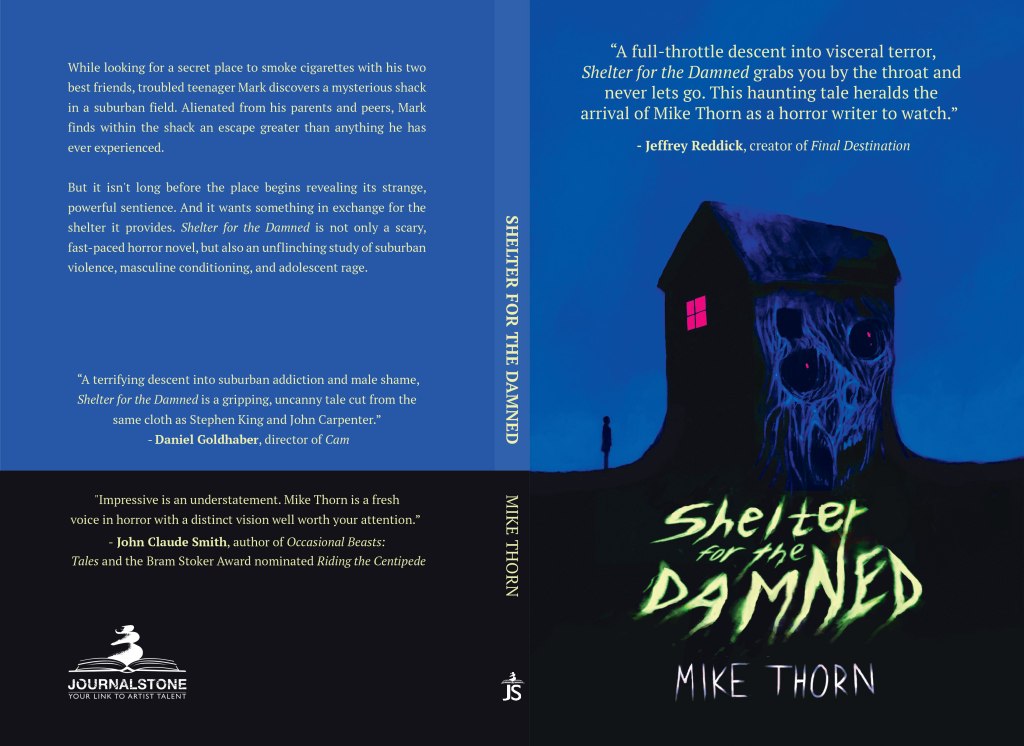
“Mike Thorn’s debut novel, Shelter For the Damned was just released from JournalStone on February 26, 2021. It recently received a 4-star review from IndieMuse. He is also the author of Darkest Hours, a short story collection.
We cornered Mike in the days leading up to his first novel release to learn a little more about him and his latest book.”
“I often write about characters who are afraid of their environments and themselves, and who want to disappear. This set of interests flies in the face of many contemporary narrative trends, which align with the mandates of social media; namely, the desire to be seen.”
At first it seems like the perfect place to quietly enjoy a secluded smoke, but three teens soon discover that their supposed safe haven is actually something downright sinister in Shelter for the Damned, the debut novel from Mike Thorn (author of the short story collection Darkest Hours). With Shelter for the Damned out now from Journalstone, we caught up with Thorn in our latest Q&A feature to discuss the journey of writing his new book, the influences that inspired him along the way, and his upcoming releases that readers can look forward to from Journalstone.
Geez, it’s been a while since we got spooky on the show, hasn’t it? High time we brought back Mike Thorn to talk about how Wes Craven fused meta storytelling and horror in two franchises: A Nightmare on Elm Street and Scream. We’ll permeate the membranes of reality, disassemble Craven’s views on horror’s social and political value, and laugh about how Matthew Lillard yells “BOO-GAH” when he imitates a gunshot.
In his latest interview, Mike Thorn answers Lou Pendergrast’s questions about Shelter for the Damned, Darkest Hours, and his new story “Deprimer” (from the latest issue of Vastarien).
“As Mark’s friendships begin to deteriorate, so too does his school and home life, making the shack feel like the only good thing in his world. I felt that one reason Mark may have been easily swayed was his own proclivity towards violence but another may have been the implied physical abuse at the hands of his father.”