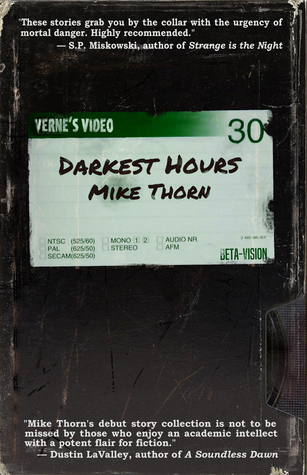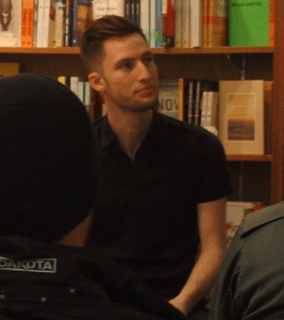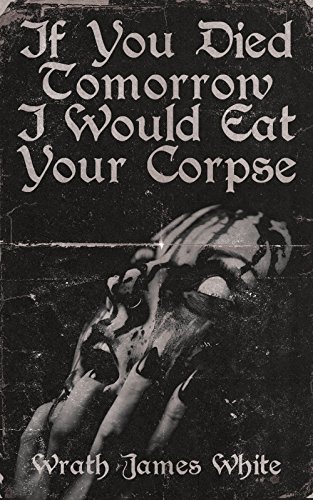
Curtis Freeman interviewed me for Cedar Hollow Horror Reviews. I discuss Darkest Hours, beer, writing rituals and many other things. Read the full interview here.
Kevin Lucia’s Mystery Road is an absorbing, emotional read

Near the end of his new novella Mystery Road, Kevin Lucia makes an explicit reference to The Twilight Zone. It’s a playful moment that exemplifies the author’s uniquely conversational prose style, but it also underlines the book’s evident genealogy. Lucia seems clearly and consciously engaged with a specific lineage of “speculative humanism,” which includes but is not limited to writers like Richard Matheson, Ray Bradbury, Stephen King, and yes, Rod Serling.
Mystery Road manages a balancing act of paying homage to these antecedents while also maintaining a personal voice and narrative. Simultaneously, it manages to dip its toes into sentimentality (a useful and effective tool when used properly) without ever soaking it up. Rather, the sentimentality serves a clear, necessary purpose: this novella actually weaves emotional catharsis into the build-up and release of its Twilight Zone-esque twist. This is a carefully built piece of fiction whose elements are brought together toward clear and affecting ends.
Much like the plot structure, the prose is remarkably lucid. Like King, Lucia recognizes the power of memory-induced imagery and sensation; also like King, he identifies the ways in which brand names and products have become irrevocably folded into American identity since the mid-twentieth century—in Mystery Road, a vintage 7UP bottle develops nearly mythic resonance.
The book also demonstrates a strongly developed sense of characterization and dialogue, which reinforce its tricky emotional through-line. Mystery Road is a talented author’s personal variation on genre traditions. It’s so clearly and elegantly written that I couldn’t help but read the whole thing in one sitting.
Devious Dialogues: Mike Thorn and A.M. Stanley on the Insidious Franchise

Given the recent release of Insidious: The Last Key, the fourth film in Leigh Whannell and James Wan’s Insidious franchise, Mike Thorn and A.M. (Anya) Stanley revisited the series for their latest talk.
Writing Horror Stories While Completing a Master’s Degree — A Surprisingly Positive Testimony

Academiology’s editors invited me to contribute a post about my experiences completing my M.A. while writing Darkest Hours.
Mike Thorn on Writer’s Block – Episode January 16, 2018

For the most recent episode of Writer’s Block on CJSW, I answered the Writer’s Block Questionnaire. The episode also features a reading by Clea Roberts and an interview with the great Suzette Mayr. Stream online.
Note: Just to be clear, when I describe Trump as someone who can be “funny,” what I mean to say is that Trump himself is a disgraceful joke worthy of mockery.
Star Wars Dialogue: V. Revision

Star Wars Dialogue: IV. The Griffith Legacy

The dialogue on Star Wars continues with a discussion over the influence of D.W. Griffith and silent cinema on George Lucas’s films.
Star Wars Dialogue on MUBI Notebook: Parts II and III
My Star Wars dialogue with Neil Bahadur, Isiah Medina, Chelsea Phillips-Carr and Isaac Goes continues on MUBI Notebook.


Part III explores the overlaps and distinctions between art and technology.
New Review of Darkest Hours in ReadingNReding

“As a graduate student, some stories in Darkest Hours hit a little too close to home. The story ‘Sabbatical,’ for example, offers a wonderful look into the agony and anxiety that accompanies the thesis writing process. This particular story shows the brilliant craftmanship behind this collection.”
Huge thanks for this!
MUBI Notebook Launches 5-Part Star Wars Series Written by Me, Chelsea Phillips-Carr, Neil Bahadur, Isaac Goes and Isiah Medina

“I’ve spent a lot of time thinking and writing about George Lucas’s work, especially his Star Wars films; I hold this six-part series in extremely high regard, especially the prequel trilogy. In my Bright Lights Film Journal article Star Wars Episode III: Revenge of the Sith: George Lucas’s Greatest Artistic Statement?, I discuss the breadth of Lucas’s extratextual reference and his brazenly unique sensibility. In George Lucas’s Wildest Vision: Retrofuturist Auteurism in Star Wars Episode II: Attack of the Clones (2002), I pay serious mind to Lucas’s interest in cinematic form and his avant-garde background, unpacking the ways in which his early experimental projects inform his later work.
For the purpose of this dialogue I wanted to hear input from several of my favorite film critics. I categorize Disney’s spin-off entries separately from Lucas’s work, given the corporation’s decision to disregard his existing outlines, but some of the contributors acknowledged the new films’ relation to (or distance from) the existing saga. I decided to pose broad, open-ended questions about these films, hoping to open up the possibilities for conversation as much as possible.”