Mike Thorn Reading from Darkest Hours on CJSW Writer’s Block

writersblock_web-780x780

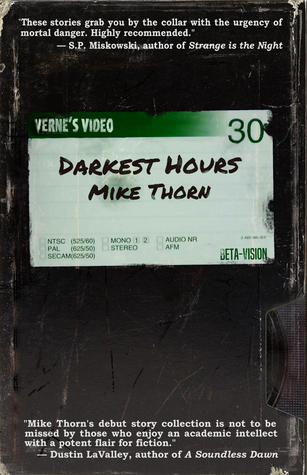
I read from my weird academic-in-distress story “Mired” (included in Darkest Hours) for the latest episode of Writer’s BlockListen to the reading.

Writer’s Block is CJSW’s monthly foray into literature. Hosted and produced by Dymphny Dronyk and sound engineered by Cody Dronyk, the program is focused on local events, writers, poets, publishers, while keeping an eye on the bigger literary picture across the country and around the world! Writer’s Block airs at 90.9 on the FM dial in Calgary on the third Tuesday of every month at 11 a.m. and 8 p.m.

Farah Rose Smith’s “The Visitor” is beautifully written dark fiction

visitor

Farah Rose Smith’s “The Visitor” does not serve simply as a delivery system for a riff on the Faustian bargain narrative; it showcases its author’s obvious attentiveness to each and every sentence, to how the lines sound and feel. This is the kind of fiction that begs to be read aloud. I find it difficult to describe good prose, but Smith writes with a seemingly effortless elegance that reminds me of some of the genre’s best stylists: think Kathe Koja, Anne Rice, Thomas Ligotti, S.P. Miskowski, Clive Barker and Gwendolyn Kiste.

I have no shortage of respect for “The Visitor”‘s form, but the content is also worth discussing. Smith writes thoughtfully and powerfully about the relationships between romanticism and destruction, between horror and seduction. This is a supernatural story, but it is also a story about the desperation and vitality of artists on the fringes, about the complicated dimensions of love. There’s an impressive amount of  subtext compressed into such a short amount of text.

The author’s biography cites her experience not only in fiction-writing, but also in the worlds of music and film. It’s all visible here. There’s a clear focus on affect and vibe and all the sensory qualities available to prose fiction, and Smith taps into these wells with a vibrancy that brings to mind Gothic post-punk, noise and experimental horror cinema. All this is to say that I thoroughly dig “The Visitor,” and that I recommend it highly to all fans of dark fiction.

Darkest Hours Reviewed on HorrorTalk

header

“The author of Darkest Hours, a collection of short stories, has truly impeccable taste. Not only did Mike Thorn complete a master’s degree thesis on John Carpenter’s Prince of Darkness, the endnotes mention his love of the influential industrial metal band Godflesh. If Mike and I ever met up for coffee, we would have a grand old time reminiscing about the mighty Godflesh, whom I haven’t seen in concert for a few years, but remain one of my personal favourite noise bands.”

Read the full review.

“Dread is an affliction”: Erin Sweet Al-Mehairi’s Breathe. Breathe.

Breathe Breathe

The speakers in Breathe. Breathe.‘s poems often toe the line between colloquial, conversational vernacular and cryptic, imagery-laden verse. Even during moments of abstraction, though, the poetry is above all else intimate and real, unafraid to state its meanings outright. Consider, for instance, the closing line in “Funhouse of Madness,” which confronts the reader with a direct question: “… but dread is an affliction, isn’t it?” To this reader, the line is exemplary of the book’s contents: Erin Sweet Al-Mehairi explores the caustic force that is fear, especially within the context of domestic violence, but she also recognizes that afflictions can be diagnosed, treated and even healed.

These poems, written almost entirely in free verse, often depict speakers seeking solace (or warding off danger) in the ludic spaces of the “natural world” – Breathe. Breathe. is rife with references to forests, lakesides, nonhuman animals and insects. The speakers often give off the impression of physical or emotional isolation, with threats or indeterminable forces lingering on the periphery, just out of sight.

And there is no shortage of threat to be found between this book’s covers; in addition to her obvious interest in folklore and magic realism, Erin Sweet Al-Mehairi showcases her commitment to the horror genre. In many ways, her short stories are even more confrontational than her poems. These narratives brutally address cycles of abuse, violent vengeance and terrifying fissures in the surface of reality.

Although Breathe. Breathe. incorporates works of both prose and poetry, it is a unified and cohesive book. The author makes good use of recurring thematic threads, imagining and reimagining her focuses within different formal contexts. This is a strange collection, full of fantastical moments and unexpected ruptures in domestic spaces, but above all else it is real. That is not necessarily a term I use often when describing works of “genre” fiction or poetry, but I think it is the one that fits best here.

Sci-Fi and Fantasy Reviewer on Darkest Hours

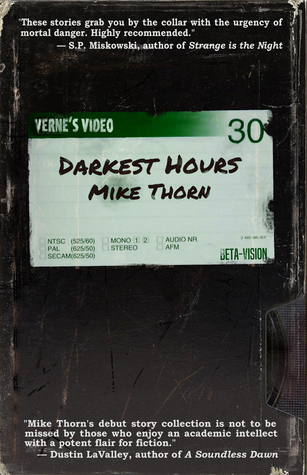
darkesthourcover“This is a fantastic collection of horror short stories, to be frank. The ability of the author to move through so many different kinds of horror scenarios, and to invoke so many different emotional responses in such a short space of time, is surely the mark of someone who ‘gets’ horror as a genre. Mr Thorn has certainly made his mark on the genre as a whole, and also on me: I look forward to reading more horror stories, and especially any more that come from his pen. I can only hope that we see more of his fiction in the near-future, and whole-heartedly recommend that you pick up this anthology.”

Read the full review.

Rebecca Gransden’s Rusticles is a Moody Collection of Anti-Narrative Stories

Image result for rusticles rebecca gransden

Rebecca Gransden’s Rusticles quickly makes two things apparent. First, it lends its focus most intently on sensory language and imagery (consider introductory story “The Neon Black”‘s opening line: “Out of the blue and into the black neon night, along a street made of pulse shaking off its dreams”). Second, this book has very little use for the standard ingredients of narrative fiction. Full of cryptic, off-kilter language and scenarios driven by obliqueness and obscurity, Rusticles declares itself as something other than a collection of plot-driven stories. In this way, it instructs the reader to read in an unusual way.

Although it bears hints of magic realism, dark fantasy and horror, the book never announces its station within a certain genre camp. Its deft and mysterious relationship to genre brings to mind the works of Daniel Braum, but Gransden’s commitments are so much different than those on display in a book like The Wish Mechanics. Rusticles is so strikingly anti-narrative that it is actually incredibly difficult to describe its contents in any detail.

The book displays interest in the possibility of loosely impressionistic fiction-writing, wherein plot is not only secondary to mood and atmosphere, but is actually lingering somewhere outside the pages. These stories are made up of residue, periphery, those ingredients which usually go ignored. It is a bold and sometimes fascinating approach to fiction-writing. Unusual syntax abounds, with occasional bursts of remarkably focused prose that borders on poetry. One line from “The Boy at the Table” stood out to me in particular: “He was a picture made of sand.” I don’t think I know what it means, but I really like the way it reads. Interestingly enough, I could apply this same sentiment to the majority of the book. Gransden demonstrates a unique point-of-view with this collection, and for that reason alone it is worth a read.

Music for a Brutal, Contemporary Planet: A Selective Alice Cooper Retrospective

It is difficult to pinpoint any individual album in Alice Cooper’s massive, eclectic discography as “summative” or “trademark.” Certainly, his original band enjoyed an inspired and singular run from 1971 (Love It to Death) to 1973 (Billion Dollar Babies), and his first official solo album Welcome to My Nightmare announced a fully realized vision of conceptual horror rock, complete with a guest appearance by Vincent Price and accompanied by a lavish, theatrical tour production. However, Cooper the solo artist is perhaps best characterized by his entire oeuvre in all its shifting, diverse and ambivalent forms — this singer-songwriter is the progenitor of shock rock as vaudevillian grand guignol; he is a meta-reflective and identity-shifting social satirist, and he is an artist of far-reaching, sophisticated conceptual range who proudly inhabits (and often embodies) that which some might call “low art.”

Read the full article in Vague Visages.

Create a website or blog at WordPress.com

Up ↑