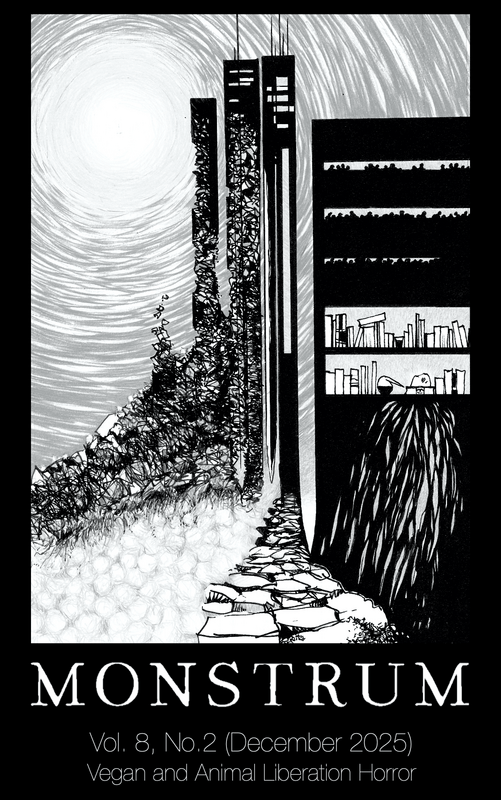
MONSTRUM 8.2: Vegan and Animal Liberation Horror, guest edited by Mike Thorn (read now!)

Monstrum vol. 8, issue 2 is now available!

Guest-edited by horror scholar and fiction writer Mike Thorn, this robust issue presents six feature essays, two works of original fiction, a dossier of retrospective reviews, and two essays in our student forum. Feature essays cover both literature and the moving image from a broad range of perspectives. From reorienting human and more-than-human animal perspectives in the essays by Poulomi Choudhury, Dru Jeffries, and Britt MacKenzie-Dale, to epistemological and ontological shifts in the way we think of human and more than-human ecologies in the essays by Zoë Anne Laks, Jenni Makahnouk, and William Taylor, and the Introduction by Mike Thorn, the contributions to this special issue explore the challenge of thinking beyond harmful anthropocentric and hegemonic capitalist world systems.

For the first time, this issue of Monstrum includes original fiction. In “The Playground,” celebrated horror author Kathe Koja (The CipherUnder the PoppyStraydog) traces a shift in ecological sensibility to what might be called a necessary violence. And with “Cogno,” Mike Thorn (Darkest HoursPeel Back and See) brings us into the terrifying world of tech-bro longevity at the expense of … maybe everything. 

A selection of retrospective reviews considers literary and cinematic texts that strive to reorient human and nonhuman animal perspectives, including a critical reassessment of the (anti-)anthropocentrism in Nobel laureate Olga Tokarczuk’s novel Drive Your Plow Over the Bones of the Dead (2018), the vegan aesthetic of Rob Zombie’s films via House of 1000 Corpses (2003), and the brutal struggle against becoming-animal in Stuart Gordon’s grim King of the Ants (2003).

The student forum includes two essays by emerging scholars that continue the issue’s investigations of radical otherness. A product of the SSHRC-funded “Horror Ecologies” workshop by CORERISC held in summer 2024 at Dawson College, Emerson Reault’s essay reads Ginger Snaps as a trans allegory, reconsidering the film’s metaphorical “curse” as less one of becoming a woman, than that of an understanding of one’s embodiment. In their essay, Luka Romney looks at radical empathy for the “animal” Other via Julia Kristeva’s concept of herethics in two of Larry Cohen’s most provocative 1970s films, It’s Alive! (1976) and It Lives Again (1978).

Peter Straub: New Critical Perspectives CFP (November 30 deadline reminder)

Proposal Submission Details

Mike Thorn seeks proposals of no more than 500 words for essays (5000-7000 words) on or related to the topics listed below.

He is especially interested in essays addressing multiple Straub-authored novels and stories, and in analyses of under-studied works, such as Straub’s poetry collections; MarriagesUnder VenusIf You Could See Me NowMr. X; and In the Night Room. He might consider close readings of individual novels or stories in some cases, but he will give preference to proposals referencing multiple texts. Send proposals and queries to mikethorn@live.com.

Proposals should include descriptive titles, preliminary reference lists, and brief, 100-word personal bios.

Chapter Topics

Pre-Gothic Straub: On the Poetry and Early Literary Novels: Proposals should address Marriages and Under Venus; they might also draw on Straub’s poetry collections.

The Early American Gothic Sequence: Proposals should address JuliaIf You Could See Me Now, and Ghost Story. They might also consider Under Venus.

Narrative Unreliability and Genre-Slipperiness: On Straub’s “Blue Rose” Novels: Proposals should address KokoMystery, and The Throat; they might also consider The Juniper Tree and Other Blue Rose Stories.

Straub Gets Weird: On Straub’s Engagements with H. P. Lovecraft and the Weird Tradition: Proposals should address the novels Mr. X and Floating Dragon. They might also consider A Dark MatterThe Talisman, or other novels or stories deemed Weird or Weird-adjacent.

American Serial Killer Mythologies: Proposals should address The Hellfire Club and A Special Place. They might also consider other novels or short stories depicting serial killers, including the “Blue Rose” novels (KokoMystery, and The Throat), The Green WomanBlack HouseMr. X, “A Short Guide to the City”, “Ashputtle”, and “Bunny is Good Bread.”

The Metafictional Straub: Intertextuality and Narrative Self-Reflection: Proposals should address lost boy lost girl and In the Night Room. They might also address the preceding Timothy Underhill “Blue Rose” novels (KokoMystery, and The Throat) and other metafictional works, such as The Buffalo Hunter and The Hellfire Club.

Straub’s Short Fiction: Proposals should address at least one story or novella from each of the following collections: Houses Without DoorsMagic TerrorInterior Darkness.

Writers and Writing in Straub’s Fiction: Proposals should address The Hellfire Club and at least one of the Timothy Underhill novels (KokoMysteryThe Throatlost boy lost girl, and In the Night Room). They might also consider Ghost Story or other novels and stories representing writers and writing, including Mrs. God, “The Juniper Tree” and “The Geezers.”

Gothic Trauma: Proposals should explore depictions of individual and collective trauma in Peter Straub’s fiction. They might address personal traumas in stories and novels like “The Juniper Tree”, “Bunny is Good Bread”, JuliaIf You Could See Me NowGhost StoryUnder VenusThe Hellfire Club,and A Dark Matter, and/or representations of PTSD and the Vietnam war in KokoThe Throat, and “The Ghost Village.”

Nonfictional Straub: Critical Commentary and Curations: Proposals should consider some of the author’s essays and introductions compiled in SidesConjunctionsPoe’s Children, “Beyond the Veil of Vision: Peter Straub and Anthony Discenza”, and American Fantastic Tales.

Straub’s Literary Legacy and Influence: Proposals should place Straub’s work in conversation with his literary successors. Proposals should examine one or more of Straub’s novels or stories in tandem with one or more works by Kelly Link, Caitlín R. Kiernan, Elizabeth Hand, Stephen Graham Jones, Brian Evenson, or another high-profile fiction writer who has publicly cited Straub’s influence.

Editor Biography

Mike Thorn is the author of Shelter for the DamnedDarkest Hours, and Peel Back and See. His scholarship has been published or is forthcoming in American Gothic StudiesThe Oxford Handbook of Shirley JacksonThe Weird: A CompanionAmerican Twilight: The Cinema of Tobe HooperThinking Horror: A Journal of Horror Philosophy, and elsewhere. He holds his PhD in English from the University of New Brunswick.

Launch discount for The Weird: A Companion (featuring a new Mike Thorn essay)

Order The Weird: A Companion, co-edited by Kristopher Woofter and Carl Sederholm, at a 30% discount using the attached flyer (offer ends May 30, 2025). This collection features contributions from Thomas Ligotti, Eugene Thacker, Jeffrey Andrew Weinstock, and many others (including a new Mike Thorn essay on Weird conventions in Darkest Hours).

 Featuring a comprehensive editors’ introduction to the Weird as a mode engaging with forms of knowledge, transcendence, and resistance, this collection offers a broad-reaching discussion of Weird fiction, film, art, and thought. Its 31 essays explore theoretical and philosophical applications of the Weird, such as Black Metal Theory, and key Weird themes and tropes such as cosmic horror, radical embodiment and sensation, dark ecological speculation, and forms of alterity. Essays are highly varied in period focus and subject matter, ranging from early Weird works by William Hope Hodgson and Conan creator Robert E. Howard, to the surrealist paintings of Leonora Carrington, to more recent works by David Lynch, Octavia Butler, and Yorgos Lanthimos.

Create a website or blog at WordPress.com

Up ↑