“I propose that horror literature, by definition, hinges on this vexed dialectic, between the affective destruction of thought and the creative process of thought (specifically, of cognizing the incognizable: the supernatural, the numinous, the unseen, the illegible). Within this dialectic, the horror writer oscillates between helpless prey to horror and the creative agent of horror.”
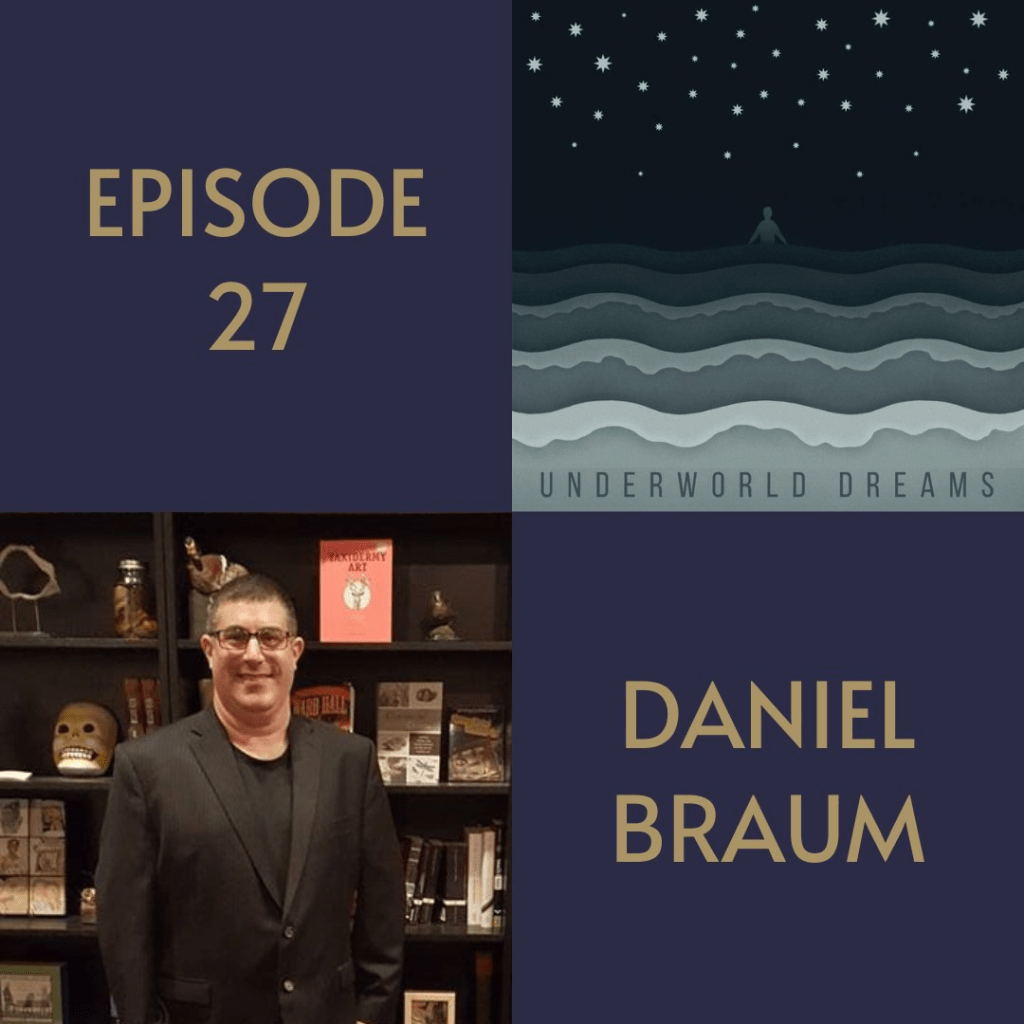
In this interview, we chat with Daniel Braum about exploring the ecology of the supernatural, finding inspiration in liminal spaces, cultivating a sense of awe, and so much more.
Daniel Braum writes short stories that explore the tension between the psychological and the supernatural. He intentionally adopts the term “strange tales” for his “Twilight Zone-like stories in homage to author Robert Aickman and the intentional ambiguities of his work. His latest collection is Phantom Constellations: Strange Tales and Ghost Stories from Cemetery Dance Publications (2025). His stories appear in places ranging from The Best Horror of the Year Volume 12, edited by Ellen Datlow, and Shivers 8, edited by Richard Chizmar.
Books and stories mentioned in this episode:
Cold Hand in Mine — Robert Aickman
The Artist’s Way — Julia Cameron
Ancient Images; The Hungry Moon — Ramsey Campbell
“Plunged in the Years” — Jeffrey Ford
“Children of the Corn” — Stephen King
The Ceremonies — T. E. D. Klein
Beginnings, Middles & Ends — Nancy Kress
Dreams of Dark and Light — Tanith Lee
Rosemary’s Baby; The Stepford Wives — Ira Levin
Story — Robert McKee
Conjunctions 83: The Ghost Issue — Joyce Carol Oates and Bradford Morrow, eds.
The Jaguar Hunter — Lucius Shepard
Shadowland — Peter Straub
Conjunctions 39: The New Wave Fabulists — Peter Straub, ed.
Harvest Home — Thomas Tryon
The Writer’s Journey: Mythic Structure for Writers — Chris Vogler
Northanger Abbey, by Jane Austen (1817) The Moonstone, by Wilkie Collins (1868) The Island of Dr. Moreau, by H. G. Wells (1896) What Maisie Knew, by Henry James (1897; 1908 New York Edition) The House of Souls, by Arthur Machen (1906) Widdershins, by Oliver Onions (1911) Summer, by Edith Wharton (1917) Tales of the Jazz Age, by F. Scott Fitzgerald (1922) The Maltese Falcon, by Dashiell Hammett (1930) Strangers on a Train, by Patricia Highsmith (1950) The Nothing Man, by Jim Thompson (1954) A Severed Head, by Iris Murdoch (1961) Aura, by Carlos Fuentes (1962) Slouching Towards Bethlehem, by Joan Didion (1968) Sula, by Toni Morrison (1973) The Coherence of Gothic Conventions, by Eve Kosofsky Sedgwick (1980) Bad Behavior, by Mary Gaitskill (1988) Ancient Images, by Ramsey Campbell (1989) Blonde, by Joyce Carol Oates (2000) Border Crossing, by Pat Barker (2001) These Truths: A History of the United States, by Jill Lepore (2018) The Best of Both Worlds, by S. P. Miskowski (2020) Hi, It’s Me, by Fawn Parker (2024) Dark Matter, by Kathe Koja (2025) Wreckage / What Happens in Hello Jack, by Peter Straub (2025)
Mike Thorn seeks proposals of no more than 500 words for essays (5000-7000 words) on or related to the topics listed below.
He is especially interested in essays addressing multiple Straub-authored novels and stories, and in analyses of under-studied works, such as Straub’s poetry collections; Marriages; Under Venus; If You Could See Me Now; Mr. X; and In the Night Room. He might consider close readings of individual novels or stories in some cases, but he will give preference to proposals referencing multiple texts. Send proposals and queries to mikethorn@live.com.
Proposals should include descriptive titles, preliminary reference lists, and brief, 100-word personal bios.
Chapter Topics
Pre-Gothic Straub: On the Poetry and Early Literary Novels: Proposals should address Marriages and Under Venus; they might also draw on Straub’s poetry collections.
The Early American Gothic Sequence: Proposals should address Julia, If You Could See Me Now, and Ghost Story. They might also consider Under Venus.
Narrative Unreliability and Genre-Slipperiness: On Straub’s “Blue Rose” Novels: Proposals should address Koko, Mystery, and The Throat; they might also consider The Juniper Tree and Other Blue Rose Stories.
Straub Gets Weird: On Straub’s Engagements with H. P. Lovecraft and the Weird Tradition: Proposals should address the novels Mr. X and Floating Dragon. They might also consider A Dark Matter, The Talisman, or other novels or stories deemed Weird or Weird-adjacent.
American Serial Killer Mythologies: Proposals should address The Hellfire Club and A Special Place. They might also consider other novels or short stories depicting serial killers, including the “Blue Rose” novels (Koko, Mystery, and The Throat), The Green Woman, Black House, Mr. X, “A Short Guide to the City”, “Ashputtle”, and “Bunny is Good Bread.”
The Metafictional Straub: Intertextuality and Narrative Self-Reflection: Proposals should address lost boy lost girl and In the Night Room. They might also address the preceding Timothy Underhill “Blue Rose” novels (Koko, Mystery, and The Throat) and other metafictional works, such as The Buffalo Hunter and The Hellfire Club.
Straub’s Short Fiction: Proposals should address at least one story or novella from each of the following collections: Houses Without Doors; Magic Terror; Interior Darkness.
Writers and Writing in Straub’s Fiction: Proposals should address The Hellfire Club and at least one of the Timothy Underhill novels (Koko, Mystery, The Throat, lost boy lost girl, and In the Night Room). They might also consider Ghost Story or other novels and stories representing writers and writing, including Mrs. God, “The Juniper Tree” and “The Geezers.”
Gothic Trauma: Proposals should explore depictions of individual and collective trauma in Peter Straub’s fiction. They might address personal traumas in stories and novels like “The Juniper Tree”, “Bunny is Good Bread”, Julia, If You Could See Me Now, Ghost Story, Under Venus, The Hellfire Club,and A Dark Matter, and/or representations of PTSD and the Vietnam war in Koko, The Throat, and “The Ghost Village.”
Nonfictional Straub: Critical Commentary and Curations: Proposals should consider some of the author’s essays and introductions compiled in Sides, Conjunctions, Poe’s Children, “Beyond the Veil of Vision: Peter Straub and Anthony Discenza”, and American Fantastic Tales.
Straub’s Literary Legacy and Influence: Proposals should place Straub’s work in conversation with his literary successors. Proposals should examine one or more of Straub’s novels or stories in tandem with one or more works by Kelly Link, Caitlín R. Kiernan, Elizabeth Hand, Stephen Graham Jones, Brian Evenson, or another high-profile fiction writer who has publicly cited Straub’s influence.
Editor Biography
Mike Thorn is the author of Shelter for the Damned, Darkest Hours, and Peel Back and See. His scholarship has been published or is forthcoming in American Gothic Studies, The Oxford Handbook of Shirley Jackson, The Weird: A Companion, American Twilight: The Cinema of Tobe Hooper, Thinking Horror: A Journal of Horror Philosophy, and elsewhere. He holds his PhD in English from the University of New Brunswick.
Continuing a new annual tradition. Titles organized by author name.
Hawksmoor, by Peter Ackroyd (1989) Dark Entries, by Robert Aickman (1964) We Are Here to Hurt Each Other, by Paula D. Ashe (2022) This Mortal Coil, by Cynthia Asquith (1947) The Damnation Game, by Clive Barker (1985) Tender is the Flesh, by Agustina Bazterrica (2017; 2020 translation by Sarah Moses) The Listener and Other Stories, by Algernon Blackwood (1907) The Scarf, by Robert Bloch (1947/1966) Something Wicked This Way Comes, by Ray Bradbury (1962) Long After Midnight: 22 Hauntings and Celebrations, by Ray Bradbury (1976) Wieland; or, The Transformation: An American Tale, by Charles Brockden Brown (1798) Ancient Images, by Ramsey Campbell (1989) The King in Yellow, by Robert W. Chambers (1895) The Juniper Tree, by Barbara Comyns (1985) The Breaking Point, by Daphne du Maurier (1959) Don’t Look Now, by Daphne du Maurier (1971) The Between, by Tananarive Due (1995) The Pines, by Robert Dunbar (1989) American Psycho, by Bret Easton Ellis (1991) Lunar Park, by Bret Easton Ellis (2005) I Have No Mouth & I Must Scream, by Harlan Ellison (1967) The Collector, by John Fowles (1963) Aura, by Carlos Fuentes (1962; 1986 translation by Lysander Kemp) Something Stirs, by Charles L. Grant (1991) Red Dragon, by Thomas Harris (1981) Twice-Told Tales, by Nathaniel Hawthorne (1837) The House of the Seven Gables, by Nathaniel Hawthorne (1851) The Woman in Black, by Susan Hill (1983) The House on the Borderland, by William Hope Hodgson (1908) The Private Memoirs and Confessions of a Justified Sinner, by James Hogg (1824) The Damned, by Joris-Karl Huysmans (1891) The Lottery and Other Stories, by Shirley Jackson (1949) Hangsaman, by Shirley Jackson (1951) The Sundial, by Shirley Jackson (1958) The Haunting of Hill House, by Shirley Jackson (1959) We Have Always Lived in the Castle, by Shirley Jackson (1962) Ghost Stories of Henry James, by Henry James (2008, edited by Martin Schofield) Ghost Stories of an Antiquary, by M. R. James (1904) Blood Secrets, by Craig Jones (1978) Uzumaki, by Junji Ito (2000; 2013 translation by Yuji Oniki) The Girl Next Door, by Jack Ketchum (1989) The Red Tree, by Caitlín R. Kiernan (2009) Carrie, by Stephen King (1974) ‘Salem’s Lot, by Stephen King (1975) The Shining, by Stephen King (1977) Cujo, by Stephen King (1981) Pet Sematary, by Stephen King (1983) It, by Stephen King (1986) Full Dark, No Stars, by Stephen King (2010) And Her Smile Will Untether the Universe, by Gwendolyn Kiste (2017) The Ceremonies, by T. E. D. Klein (1984) The Cipher, by Kathe Koja (1991) Bad Brains, by Kathe Koja (1992) Skin, by Kathe Koja (1993) Conjure Wife, by Fritz Leiber (1943) The Fifth Child, by Doris Lessing (1988) Rosemary’s Baby, by Ira Levin (1967) The Stepford Wives, by Ira Levin (1972) The Monk: A Romance, by Matthew Gregory Lewis (1796) Songs of a Dead Dreamer and Grimscribe, by Thomas Ligotti (2015) The Hounds of Tindalos, by Frank Belknap Long (1946) Tales of H. P. Lovecraft, by H. P. Lovecraft (2007, edited by Joyce Carol Oates) The House of Souls, by Arthur Machen (1906) Burnt Offerings, by Robert Marasco (1973) The Beetle, by Richard Marsh (1897) I Am Legend, by Richard Matheson (1954) Shock!, by Richard Matheson (1961) Melmoth the Wanderer, by Charles Robert Maturin (1820) Child of God, by Cormac McCarthy (1973) Toplin, by Michael McDowell, (1985) Heartbreaker, by Maryse Meijer (2016) The Seventh Mansion, by Maryse Meijer (2020) Strange is the Night, by S. P. Miskowski (2017) Beloved, by Toni Morrison (1987) Zombie, by Joyce Carol Oates (1995) Jack of Spades, by Joyce Carol Oates (2015) Widdershins, by Oliver Onions (1911) Selected Writings of Edgar Allan Poe, by Edgar Allan Poe (1956, edited by Edward H. Davidson) The Mysteries of Udolpho, by Ann Radcliffe (1794) Interview with the Vampire, by Anne Rice (1976) Traplines, by Eden Robinson (1996) The Subjugated Beast, by R. R. Ryan (1938) The Room, by Hubert Selby Jr. (1971) The Demon, by Hubert Selby Jr. (1976) New Stories from the Twilight Zone, by Rod Serling (1965) Frankenstein; or, the Modern Prometheus, by Mary Shelley (1818) The House Next Door, by Anne Rivers Siddons (1978) The Dark Eidolon and Other Fantasies, by Clark Ashton Smith (2014, edited by S. T. Joshi) Strange Case of Dr. Jekyll and Mr. Hyde, by Robert Louis Stevenson (1886) Dracula, by Bram Stoker (1897) Julia, by Peter Straub (1975) Ghost Story, by Peter Straub (1979) Koko, by Peter Straub (1988) Houses without Doors, by Peter Straub (1990) The Other, by Thomas Tryon (1971) Ghosts, by Edith Wharton (1937) The Picture of Dorian Gray, by Oscar Wilde (1890) The Island of Doctor Moreau, by H. G. Wells (1896) The Invisible Man, by H. G. Wells (1897) The Sailor Who Fell from Grace with the Sea, by Yukio Mishima (1963)
In this interview, we chat with Ramsey Campbell about creative instincts, happy accidents, eerie children’s tales, and so much more.
The Oxford Companion to English Literature describes Ramsey Campbell as “Britain’s most respected living horror writer”, and the Washington Post sums up his work as “one of the monumental accomplishments of modern popular fiction”. His awards include the Grand Master Award of the World Horror Convention, the Lifetime Achievement Award of the Horror Writers Association, the Living Legend Award of the International Horror Guild and the World Fantasy Lifetime Achievement Award. In 2015 he was made an Honorary Fellow of Liverpool John Moores University for outstanding services to literature. His latest novels are Fellstones, The Lonely Lands, The Incubations and An Echo of Children. His Brichester Mythos trilogy consists of The Searching Dead, Born to the Dark and The Way of the Worm. His collections include Waking Nightmares, Ghosts and Grisly Things, Told by the Dead, Just Behind You, Holes for Faces, By the Light of My Skull, Fearful Implications, and a two-volume retrospective roundup (Phantasmagorical Stories) as well as The Village Killings and Other Novellas. His non-fiction is collected as Ramsey Campbell, Probably and Ramsey Campbell, Certainly, while Ramsey’s Rambles collects his video reviews, and Six Stooges and Counting is a book-length study of the Three Stooges. Limericks of the Alarming and Phantasmal is a history of horror fiction in the form of fifty limericks.
Books and stories mentioned in this episode:
The Atrocity Exhibition – J. G. Ballard
Great Short Stories of the World – Barrett H. Clark and Maxim Lieber, eds.
“A Dark-Brown Dog”; The Red Badge of Courage – Stephen Crane
The Man Within – Graham Greene
“The Residence at Whitminster” – M. R. James
Rosemary’s Baby; The Stepford Wives – Ira Levin
Tales of Mean Streets – Arthur Morrison
Lolita; Pale Fire – Vladimir Nabokov
“The Telltale Heart” – Edgar Allan Poe
At the Foot of the Story Tree: An Inquiry into the Fiction of Peter Straub – Bill Sheehan
Ghost Story – Peter Straub
The Rupert Bear series – Herbert Tourtel & Mary Tourtel
“Afterward” – Edith Wharton
At Night, White Bracken; To Those from Below – Gareth Wood
Peter Straub: New Critical Perspectives (edited by Mike Thorn)
In his introduction to John C. Tibbetts’s The Gothic Worlds of Peter Straub (2016)—the only academic, book-length study of Straub’s fiction currently in print—Gary K. Wolfe argues that “[p]erhaps more than any author of his generation—Stephen King included—Straub extended the literary possibilities of horror fiction.” Despite Peter Straub’s legacy as a leading figure in late twentieth- and early twenty-first-century horror fiction, and his influence on dark fiction writers ranging from Caitlín R. Kiernan to Stephen Graham Jones, there is currently a scarcity of scholarship on his oeuvre. Since his passing in September 2022, Straub’s work has seen increased attention. Penguin Random House is rereleasing most of his books in 2025 and Subterranean Press is scheduled to publish his unfinished final novel, Wreckage, later this year. Stephen King, who co-authored The Talisman (1984) and Black House (2001) with Straub, recently announced that he has completed the final instalment in their collaborative trilogy, and in 2022, Emma Straub published This Time Tomorrow, a celebrated novel about her father.
Mike Thorn is collaborating with the University Press of Mississippi to publish Peter Straub: New Critical Perspectives, which will offer the first multiple-authored academic anthology on Peter Straub. This volume will provide an array of critical perspectives on Straub’s robust body of work, addressing the author’s place in the Gothic and Weird traditions and examining his thematic fixations, including national and individual traumas; abusive mentors and authority figures; supernatural manifestations of material misdeeds; America’s mythologizing of serial killers; the fraught distinctions between “literary” and “commercial” fiction; the vexing instability of assumed “truths” and “realities”; and the infinitely complex nature of narrative as such—its formal malleability, its capacity for phenomenological and ontological rupture, its social functions, and its potentials and dangers. The collection will address Straub’s previously understudied pre-Gothic poetry and novels, Marriages and Under Venus, as well as his popularly celebrated and award-winning novels (including Ghost Story, Floating Dragon, and Koko), his collaborations with Stephen King (The Talisman and Black House) and his short stories and critical essays. The book will be geared towards a broad readership—from undergraduate and graduate university students, to interested general readers, to scholars and researchers seeking original insights into Straub, the American Gothic, and horror fiction writ large.
Proposal Submission Details
Mike Thorn seeks proposals of no more than 500 words for essays (5000-7000 words) on or related to the topics listed below (proposals should include descriptive titles and preliminary reference lists). He is especially interested in essays addressing multiple Straub-authored novels and stories, and in analyses of under-studied works, such as Straub’s poetry collections; Marriages; Under Venus; If You Could See Me Now; Mr. X; and In the Night Room. He might consider close readings of individual novels or stories in some cases, but he will give preference to proposals referencing multiple texts. Please include a brief, 100-word personal bio. Send proposals and queries to mikethorn@live.com.
Chapter Topics
Pre-Gothic Straub: On the Poetry and Early Literary Novels: Proposals should address Marriages and Under Venus; they might also draw on Straub’s poetry collections.
The Early American Gothic Sequence: Proposals should address Julia, If You Could See Me Now, and Ghost Story. They might also consider Under Venus.
Narrative Unreliability and Genre-Slipperiness: On Straub’s “Blue Rose” Novels: Proposals should address Koko, Mystery, and The Throat; they might also consider The Juniper Tree and Other Blue Rose Stories.
Straub Gets Weird: On Straub’s Engagements with H. P. Lovecraft and the Weird Tradition: Proposals should address the novels Mr. X and Floating Dragon. They might also consider A Dark Matter, The Talisman, or other novels or stories deemed Weird or Weird-adjacent.
American Serial Killer Mythologies: Proposals should address The Hellfire Club and A Special Place. They might also consider other novels or short stories depicting serial killers, including the “Blue Rose” novels (Koko, Mystery, and The Throat), The Green Woman, Black House, Mr. X, “A Short Guide to the City”, “Ashputtle”, and “Bunny is Good Bread.”
The Metafictional Straub: Intertextuality and Narrative Self-Reflection: Proposals should address lost boy lost girl and In the Night Room. They might also address the preceding Timothy Underhill “Blue Rose” novels (Koko, Mystery, and The Throat) and other metafictional works, such as The Buffalo Hunter and The Hellfire Club.
Straub’s Short Fiction: Proposals should address at least one story or novella from each of the following collections: Houses Without Doors; Magic Terror; Interior Darkness.
Writers and Writing in Straub’s Fiction: Proposals should address The Hellfire Club and at least one of the Timothy Underhill novels (Koko, Mystery, The Throat, lost boy lost girl, and In the Night Room). They might also consider Ghost Story or other novels and stories representing writers and writing, including Mrs. God, “The Juniper Tree” and “The Geezers.”
Gothic Trauma: Proposals should explore depictions of individual and collective trauma in Peter Straub’s fiction. They might address personal traumas in stories and novels like “The Juniper Tree”, “Bunny is Good Bread”, Julia, If You Could See Me Now, Ghost Story, Under Venus, The Hellfire Club,and A Dark Matter, and/or representations of PTSD and the Vietnam war in Koko, The Throat, and “The Ghost Village.”
Nonfictional Straub: Critical Commentary and Curations: Proposals should consider some of the author’s essays and introductions compiled in Sides, Conjunctions, Poe’s Children, “Beyond the Veil of Vision: Peter Straub and Anthony Discenza”, and American Fantastic Tales.
Straub’s Literary Legacy and Influence: Proposals should place Straub’s work in conversation with his literary successors. Proposals should examine one or more of Straub’s novels or stories in tandem with one or more works by Kelly Link, Caitlín R. Kiernan, Elizabeth Hand, Stephen Graham Jones, Brian Evenson, or another high-profile fiction writer who has publicly cited Straub’s influence.
Preliminary Publication timeline
Deadline for proposals: November 30, 2025 Deadline for papers: January 1, 2027 Editor feedback: March 1, 2027 Deadline for final, revised papers: July 1, 2027 Manuscript submitted to University Press of Mississippi: September 1, 2027 Tentatively scheduled publication date: September 2028
Editor Biography
Mike Thorn, PhD, is the author of Shelter for the Damned, Darkest Hours, and Peel Back and See. His scholarship has been published or is forthcoming in American Gothic Studies, The Oxford Handbook of Shirley Jackson, The Weird: A Companion, American Twilight: The Cinema of Tobe Hooper, Thinking Horror: A Journal of Horror Philosophy, and elsewhere. He co-hosts the writing-themed Craftwork podcast with Miriam Richer.









 Mike Thorn