What do you desire from the natural world? For millions of years, we’ve been shaped and reshaped by the environment around us. If technology has the power to mimic lush lands and blue waters, how do we bond if we can’t tell what is real or not—or worse, does it even matter? In this issue, we journey through galaxies where love knows no bounds, nature that heals, wild hearts to be untamed, plants that lust.
In this interview, we chat with Kasia Van Schaik about reverse outlining, asking “what if”, sublimating emotion through landscape, and so much more.
Kasia Van Schaik is the author of the Giller Prize-nominated story collection We Have Never Lived on Earth and the forthcoming book of memoir and cultural criticism, Women Among Monuments. With Myra Bloom, she is the co-editor of the essay collection, Shelter in Text: Essays on Dwelling and Refuge. Kasia’s writing has appeared in Electric Literature, the LA Review of Books, Room, The Rumpus, the Best Canadian Poetry, and the CBC. Kasia holds a PhD in literature from McGill University and is assistant professor of English and co-director of Creative Writing at the University of New Brunswick in Fredericton, Wolastoqiyik territory.
Books mentioned in this episode:
Wuthering Heights — Emily Brontë
The Secret Garden — Frances Hodgson Burnett
Autobiography of Red — Anne Carson
Boyhood; Youth; Summertime — J. M. Coetzee
Outline; Transit; Kudos — Rachel Cusk
The Days of Abandonment; the Neapolitan Quartet — Elena Ferrante
In this interview, we chat with Jean Marc Ah-Sen about comic books, literary scenes, flipping the script on what a book can be, and so much more.
Jean Marc Ah-Sen is the author of Grand Menteur, In the Beggarly Style of Imitation, and Kilworthy Tanner. His writing has appeared in McSweeney’s Quarterly Concern, Literary Hub, Catapult, The Comics Journal, Maclean’s, The Walrus, and elsewhere.
Books mentioned in this episode:
The Fall – Albert Camus
I Dreamed I Was a Very Clean Tramp – Richard Hell
The Talented Mr. Ripley – Patricia Highsmith
Intimacy – Hanif Kureishi
Biography of X – Catherine Lacey
Ada or Ardor: A Family Chronicle – Vladimir Nabokov
Anti-Woo: The Lifeman’s Improved Primer for Non-Lovers; The Theory and Practice of Gamesmanship: Or the Art of Winning Games Without Actually Cheating – Stephen Potter
Lobotomy: Surviving the Ramones – Dee Dee Ramone
Endling – Maria Reva
The Dying Animal – Philip Roth
Striptease – Georges Simenon
The Handyman Method – Andrew Sullivan
Anna Karenina – Leo Tolstoy
The Island of Doctor Moreau; The Time Machine – H. G. Wells
In this interview, we chat with Ramsey Campbell about creative instincts, happy accidents, eerie children’s tales, and so much more.
The Oxford Companion to English Literature describes Ramsey Campbell as “Britain’s most respected living horror writer”, and the Washington Post sums up his work as “one of the monumental accomplishments of modern popular fiction”. His awards include the Grand Master Award of the World Horror Convention, the Lifetime Achievement Award of the Horror Writers Association, the Living Legend Award of the International Horror Guild and the World Fantasy Lifetime Achievement Award. In 2015 he was made an Honorary Fellow of Liverpool John Moores University for outstanding services to literature. His latest novels are Fellstones, The Lonely Lands, The Incubations and An Echo of Children. His Brichester Mythos trilogy consists of The Searching Dead, Born to the Dark and The Way of the Worm. His collections include Waking Nightmares, Ghosts and Grisly Things, Told by the Dead, Just Behind You, Holes for Faces, By the Light of My Skull, Fearful Implications, and a two-volume retrospective roundup (Phantasmagorical Stories) as well as The Village Killings and Other Novellas. His non-fiction is collected as Ramsey Campbell, Probably and Ramsey Campbell, Certainly, while Ramsey’s Rambles collects his video reviews, and Six Stooges and Counting is a book-length study of the Three Stooges. Limericks of the Alarming and Phantasmal is a history of horror fiction in the form of fifty limericks.
Books and stories mentioned in this episode:
The Atrocity Exhibition – J. G. Ballard
Great Short Stories of the World – Barrett H. Clark and Maxim Lieber, eds.
“A Dark-Brown Dog”; The Red Badge of Courage – Stephen Crane
The Man Within – Graham Greene
“The Residence at Whitminster” – M. R. James
Rosemary’s Baby; The Stepford Wives – Ira Levin
Tales of Mean Streets – Arthur Morrison
Lolita; Pale Fire – Vladimir Nabokov
“The Telltale Heart” – Edgar Allan Poe
At the Foot of the Story Tree: An Inquiry into the Fiction of Peter Straub – Bill Sheehan
Ghost Story – Peter Straub
The Rupert Bear series – Herbert Tourtel & Mary Tourtel
“Afterward” – Edith Wharton
At Night, White Bracken; To Those from Below – Gareth Wood
In this interview, we chat with Michael LaPointe about navigating the pipeline between impulse and expression, breaking the genteel picture of literature, finding liberation in failure, and so much more.
Michael LaPointe is the author of The Creep, a novel published by Random House Canada. He has written for The New Yorker and The Atlantic, and he was a columnist with The Paris Review. His work has been anthologized in Best Canadian Stories and Best Canadian Essays, and he lives in Toronto.
Books mentioned in this episode:
Affliction; Continental Drift; Rule of the Bone; The Sweet Hereafter – Russell Banks
Naked Lunch – William S. Burroughs
The Adventures of Pinocchio – Carlo Collodi
Bleak House – Charles Dickens
Play it as it Lays – Joan Didion
The Lover – Marguerite Duras
Middlemarch – George Eliot
American Psycho; Less Than Zero; The Shards – Bret Easton Ellis
Madame Bovary – Gustave Flaubert
Bad Behavior; Two Girls, Fat and Thin – Mary Gaitskill
In a Lonely Place – Dorothy B. Hughes
Snow Country – Yasunari Kawabata
Playing in the Dark: Whiteness and the Literary Imagination; Sula – Toni Morrison
The Sorrow of War – Bảo Ninh
Inherent Vice – Thomas Pynchon
All Quiet on the Western Front – Erich Maria Remarque
Voyage in the Dark – Jean Rhys
Catcher in the Rye – J. D. Salinger
Last Exit to Brooklyn – Hubert Selby Jr.
Alice James: A Biography – Jean Strouse
The Invisible Woman: The Story Of Nelly Ternan And Charles Dickens – Claire Tomalin
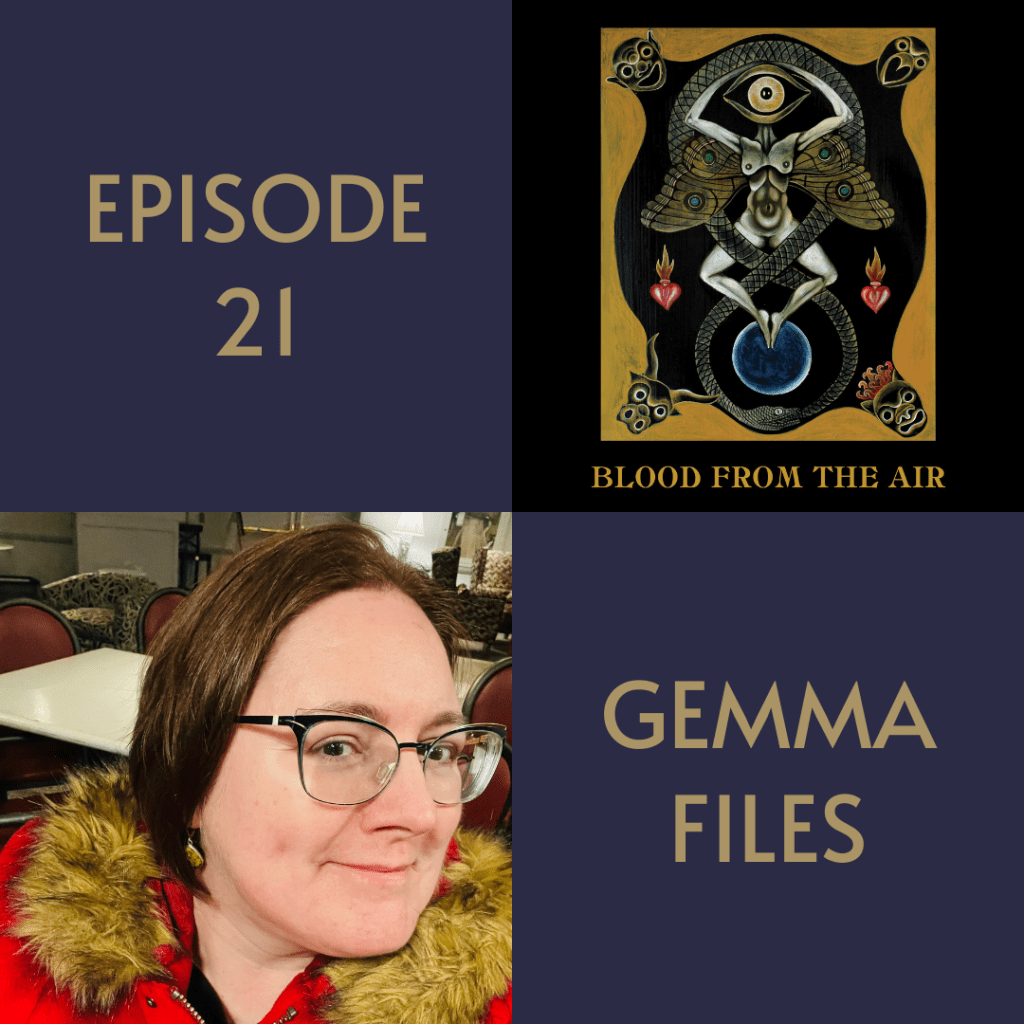
In this interview, we chat with Gemma Files about horny monsters, Lovecraftian Airbnbs, the female gaze, and so much more.
Previously a film critic, journalist and teacher, Gemma Files has been an award-winning horror author since 1999. She’s best-known for her novel Experimental Film (Open Road Media) and her collections of short fiction, including the Bram Stoker Award-winning In That Endlessness, Our End and Blood From the Air (both from Grimscribe). Her next book, Little Horn: Stories, will be out in October from Shortwave. She is the autistic mother of an autistic son. For fun she sings, and doodles pretty monsters.
Books mentioned in this episode:
Empire of the Sun – J. G. Ballard
D’Aulaire’s Book of Greek Myths; Norse Gods and Giants – Edgar Parin d’Aulaire and Ingri Parin d’Aulaire
Black Flame – Gretchen Felker-Martin
The Rotting Room – Viggy Parr Hampton
Barrowbeck; The Loney; Starve Acre – Andrew Michael Hurley
Bright Dead Star; Zoetrope Bizarre – Caitlín R. Kiernan
The Jungle Book; The Second Jungle Book – Rudyard Kipling
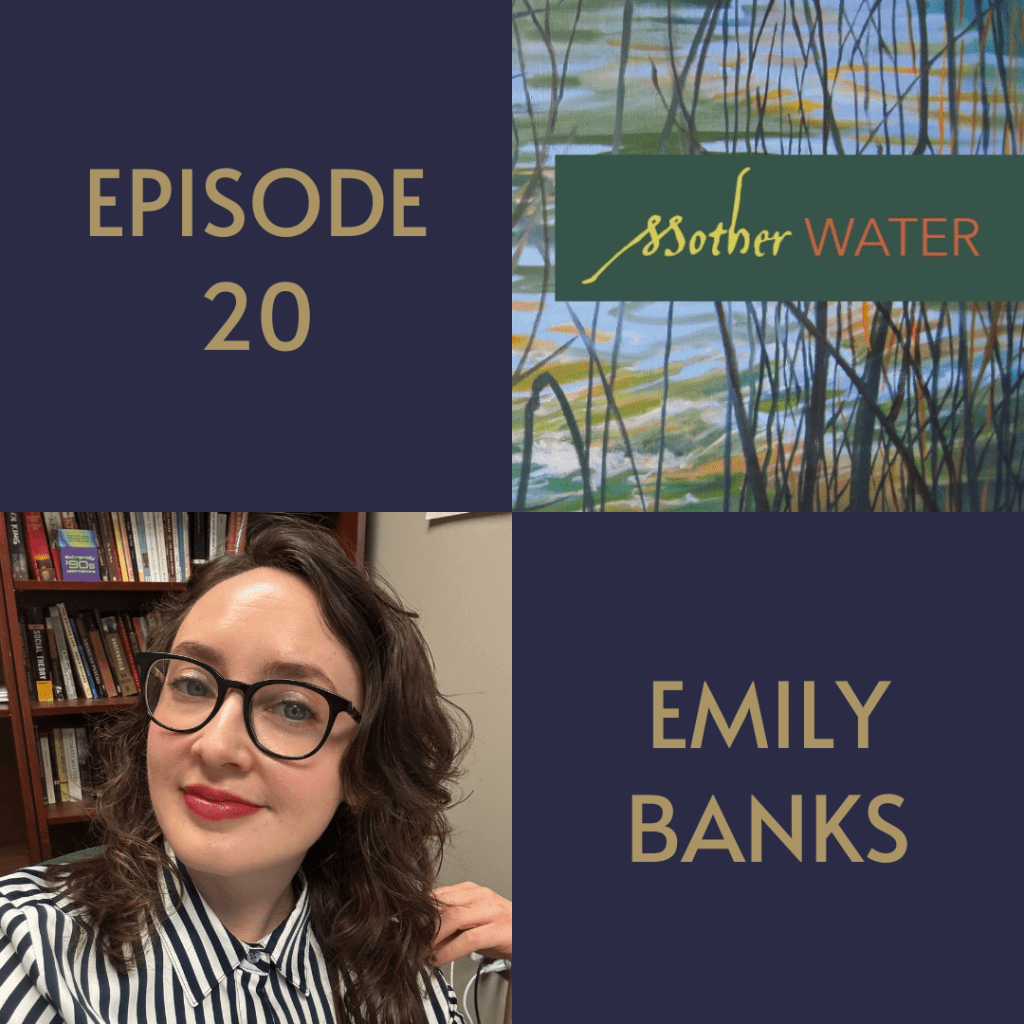
In this interview, we chat with Emily Banks about posthumous publications, linguistic allergies, the atomic nuts and bolts of imagery, and so much more.
Emily Banks is the author of Mother Water (Lynx House Press, 2020). Her poems have appeared in Plume, Copper Nickel, 32 Poems, The Rumpus, CutBank, Mid-American Review, and other journals. She publishes scholarship on American gothic literature, runs The Shirley Jackson Society, and is currently editing The Oxford Handbook of Shirley Jackson. She holds an MFA from the University of Maryland and a Ph.D. from Emory University. She lives in Indianapolis and teaches at Franklin College.
Books, poems, and stories mentioned in this episode:
“Filling Station”; “In the Waiting Room” – Elizabeth Bishop
Alice’s Adventures in Wonderland – Lewis Carroll
Turn Up the Ocean – Tony Hoagland
“Dorothy and My Grandmother and the Sailors”; Hangsaman; The Haunting of Hill House; We Have Always Lived in the Castle – Shirley Jackson
Bliss Montage; Severance – Ling Ma
How to Do Nothing: Resisting the Attention Economy – Jenny Odell
In this interview, we chat with Naben Ruthnum about character development, avoiding TV-brained writing, making sense of first-reader notes, and so much more.
Naben Ruthnum is a Toronto-based writer of fiction, cultural criticism, film and TV. His novel A Hero of Our Time was released by Penguin Random House and was optioned for development by The Littlefield Company. His books include the YA novel The Grimmer, the World Fantasy Award-nominated horror novella Helpmeet and two thrillers penned as Nathan Ripley, both of which have been optioned for development and were published internationally. He has written for Canadian television series including Murdoch Mysteries and Cardinal. As a feature screenwriter, he’s collaborated with Kris Bertin for feature and TV projects in development at Oddfellows, BoulderLight Pictures, Automatik, Skybound, and Blink49. Kris and Naben’s script Road Test made the 2024 Black List.
Books mentioned in this episode:
A Clockwork Orange – Anthony Burgess
The Sorceress in Stained Glass & Other Ghost Stories – Richard Dalby, ed.
The Name of the Rose – Umberto Eco
The Black Dahlia; Killer on the Road; L.A. Confidential; My Dark Places – James Ellroy
Black Flame – Gretchen Felker-Martin
The James Bond series – Ian Fleming
The Collector; The Magus – John Fowles
The Green Carnation – Robert Hichens
The Americans; The Tragic Muse; The Turn of the Screw – Henry James
Supernatural Horror in Literature – H. P. Lovecraft
The Beckoning Fair One – Oliver Onions
A Fatal Inversion; Master of the Moor – Ruth Rendell
Flicker – Theodore Roszak
The Tempest – William Shakespeare
Ghost Story; If You Could See Me Now; In the Night Room; Koko; The Throat – Peter Straub
The Secret History – Donna Tartt
A Dark-Adapted Eye; The House of Stairs – Barbara Vine
In this interview, we chat with Sarah Bernstein about contemplation, finding time for writing, capturing the rush of language, and so much more.
Sarah Bernstein is the author of two novels, The Coming Bad Days and Study for Obedience, which was shortlisted for the Booker Prize. She is from Montreal and lives in the Scottish Highlands.
Books and stories mentioned in this episode:
Hysteric; Whore – Nelly Arcan
Giovanni’s Room – James Baldwin
The Moonstone; The Woman in White – Wilkie Collins
“A Mown Lawn” – Lydia Davis
Shirley Jackson: A Rather Haunted Life – Ruth Franklin
The Book of Questions – Edmond Jabès
The Haunting of Hill House; “The Lottery”; The Sundial; We Have Always Lived in the Castle – Shirley Jackson
The Melancholy of Resistance – László Krasznahorkai
The Place of Shells – Mai Ishizawa
In the Wake: On Blackness and Being – Christina Sharpe
In this interview, we chat with S. P. Miskowski about Asian horror cinema, the power of grief, the relentless desire to shape the self, and so much more.
S. P. Miskowski is a recipient of two National Endowment for the Arts Fellowships, for literature and for drama. Her books have been recognized with four Shirley Jackson Award nominations and two Bram Stoker Award nominations. Her stories have appeared in many anthologies including Haunted Nights, Human Monsters, Looming Low I and II, The Madness of Dr. Caligari, Uncertainties III, October Dreams 2, The Best Horror of the Year Vol. 10, and Darker Companions: 50 Years of Ramsey Campbell, and in magazines including Identity Theory, Black Static, Vastarien, Supernatural Tales, and Cosmic Horror Monthly. Her grunge noir novel I Wish I Was Like You was named This Is Horror Novel of the Year 2017 and is available via Audible. An omnibus of her books set in the weird fictional town of Skillute, WA is forthcoming from Broken Eye Books in 2025.
Books and stories mentioned in this episode:
The Brothers Grimm Fairy Tales – Alfred A. Knopf, pub.
The Best American Mystery and Suspense 2024 – S. A. Cosby, ed.
D’Aulaires Book of Greek Myths – Ingrid & Edgar Parin d’Aulaire
Go, Dog. Go! – P. D. Eastman
Rock Paper Scissors – Alice Feeney
The Haunting of Hill House; “Maybe it Was the Car”; “The Summer People”; We Have Always Lived in the Castle; “The Witch” – Shirley Jackson
None of This is True – Lisa Jewell
Audition – Ryū Murakami
“Bluebeard”; “Cinderella” – Charles Perrault
“The Black Cat”; “The Cask of Amontillado” – Edgar Allan Poe
The Last Party – A. R. Torre
The Best American Mystery and Suspense 2023 – Lisa Unger, ed.