100 Favorite Horror Books: October 2025 Edition

Continuing a new annual tradition. Titles organized by author name.

Hawksmoor, by Peter Ackroyd (1989)
Dark Entries, by Robert Aickman (1964)
We Are Here to Hurt Each Other, by Paula D. Ashe (2022)
This Mortal Coil, by Cynthia Asquith (1947)
The Damnation Game, by Clive Barker (1985)
Tender is the Flesh, by Agustina Bazterrica (2017; 2020 translation by Sarah Moses)
The Listener and Other Stories, by Algernon Blackwood (1907)
The Scarf, by Robert Bloch (1947/1966)
Something Wicked This Way Comes, by Ray Bradbury (1962)
Long After Midnight: 22 Hauntings and Celebrations, by Ray Bradbury (1976)
Wieland; or, The Transformation: An American Tale, by Charles Brockden Brown (1798)
Ancient Images, by Ramsey Campbell (1989)
The King in Yellow, by Robert W. Chambers (1895)
The Juniper Tree, by Barbara Comyns (1985)
The Breaking Point, by Daphne du Maurier (1959)
Don’t Look Now, by Daphne du Maurier (1971)
The Between, by Tananarive Due (1995)
The Pines, by Robert Dunbar (1989)
American Psycho, by Bret Easton Ellis (1991)
Lunar Park, by Bret Easton Ellis (2005)
I Have No Mouth & I Must Scream, by Harlan Ellison (1967)
The Collector, by John Fowles (1963)
Aura, by Carlos Fuentes (1962; 1986 translation by Lysander Kemp)
Something Stirs, by Charles L. Grant (1991)
Red Dragon, by Thomas Harris (1981)
Twice-Told Tales, by Nathaniel Hawthorne (1837)
The House of the Seven Gables, by Nathaniel Hawthorne (1851)
The Woman in Black, by Susan Hill (1983)
The House on the Borderland, by William Hope Hodgson (1908)
The Private Memoirs and Confessions of a Justified Sinner, by James Hogg (1824)
The Damned, by Joris-Karl Huysmans (1891)
The Lottery and Other Stories, by Shirley Jackson (1949)
Hangsaman, by Shirley Jackson (1951)
The Sundial, by Shirley Jackson (1958)
The Haunting of Hill House, by Shirley Jackson (1959)
We Have Always Lived in the Castle, by Shirley Jackson (1962)
Ghost Stories of Henry James, by Henry James (2008, edited by Martin Schofield)
Ghost Stories of an Antiquary, by M. R. James (1904)
Blood Secrets, by Craig Jones (1978)
Uzumaki, by Junji Ito (2000; 2013 translation by Yuji Oniki)
The Girl Next Door, by Jack Ketchum (1989)
The Red Tree, by Caitlín R. Kiernan (2009)
Carrie, by Stephen King (1974)
‘Salem’s Lot, by Stephen King (1975)
The Shining, by Stephen King (1977)
Cujo, by Stephen King (1981)
Pet Sematary, by Stephen King (1983)
It, by Stephen King (1986)
Full Dark, No Stars, by Stephen King (2010)
And Her Smile Will Untether the Universe, by Gwendolyn Kiste (2017)
The Ceremonies, by T. E. D. Klein (1984)
The Cipher, by Kathe Koja (1991)
Bad Brains, by Kathe Koja (1992)
Skin, by Kathe Koja (1993)
Conjure Wife, by Fritz Leiber (1943)
The Fifth Child, by Doris Lessing (1988)
Rosemary’s Baby, by Ira Levin (1967)
The Stepford Wives, by Ira Levin (1972)
The Monk: A Romance, by Matthew Gregory Lewis (1796)
Songs of a Dead Dreamer and Grimscribe, by Thomas Ligotti (2015)
The Hounds of Tindalos, by Frank Belknap Long (1946)
Tales of H. P. Lovecraft, by H. P. Lovecraft (2007, edited by Joyce Carol Oates)
The House of Souls, by Arthur Machen (1906)
Burnt Offerings, by Robert Marasco (1973)
The Beetle, by Richard Marsh (1897)
I Am Legend, by Richard Matheson (1954)
Shock!, by Richard Matheson (1961)
Melmoth the Wanderer, by Charles Robert Maturin (1820)
Child of God, by Cormac McCarthy (1973)
Toplin, by Michael McDowell, (1985)
Heartbreaker, by Maryse Meijer (2016)
The Seventh Mansion, by Maryse Meijer (2020)
Strange is the Night, by S. P. Miskowski (2017)
Beloved, by Toni Morrison (1987)
Zombie, by Joyce Carol Oates (1995)
Jack of Spades, by Joyce Carol Oates (2015)
Widdershins, by Oliver Onions (1911)
Selected Writings of Edgar Allan Poe, by Edgar Allan Poe (1956, edited by Edward H. Davidson)
The Mysteries of Udolpho, by Ann Radcliffe (1794)
Interview with the Vampire, by Anne Rice (1976)
Traplines, by Eden Robinson (1996)
The Subjugated Beast, by R. R. Ryan (1938)
The Room, by Hubert Selby Jr. (1971)
The Demon, by Hubert Selby Jr. (1976)
New Stories from the Twilight Zone, by Rod Serling (1965)
Frankenstein; or, the Modern Prometheus, by Mary Shelley (1818)
The House Next Door, by Anne Rivers Siddons (1978)
The Dark Eidolon and Other Fantasies, by Clark Ashton Smith (2014, edited by S. T. Joshi)
Strange Case of Dr. Jekyll and Mr. Hyde, by Robert Louis Stevenson (1886)
Dracula, by Bram Stoker (1897)
Julia, by Peter Straub (1975)
Ghost Story, by Peter Straub (1979)
Koko, by Peter Straub (1988)
Houses without Doors, by Peter Straub (1990)
The Other, by Thomas Tryon (1971)
Ghosts, by Edith Wharton (1937)
The Picture of Dorian Gray, by Oscar Wilde (1890)
The Island of Doctor Moreau, by H. G. Wells (1896)
The Invisible Man, by H. G. Wells (1897)
The Sailor Who Fell from Grace with the Sea, by Yukio Mishima (1963)

Craftwork Episode 23: Dreaming in Fire, Working in Clay, & Reaching for Awe w/ Ramsey Campbell

Listen to Craftwork Episode 23: Dreaming in Fire, Working in Clay, & Reaching for Awe w/ Ramsey Campbell.

In this interview, we chat with Ramsey Campbell about creative instincts, happy accidents, eerie children’s tales, and so much more.

The Oxford Companion to English Literature describes Ramsey Campbell as “Britain’s most respected living horror writer”, and the Washington Post sums up his work as “one of the monumental accomplishments of modern popular fiction”. His awards include the Grand Master Award of the World Horror Convention, the Lifetime Achievement Award of the Horror Writers Association, the Living Legend Award of the International Horror Guild and the World Fantasy Lifetime Achievement Award. In 2015 he was made an Honorary Fellow of Liverpool John Moores University for outstanding services to literature. His latest novels are Fellstones, The Lonely Lands, The Incubations and An Echo of Children. His Brichester Mythos trilogy consists of The Searching Dead, Born to the Dark and The Way of the Worm. His collections include Waking Nightmares, Ghosts and Grisly Things, Told by the Dead, Just Behind You, Holes for Faces, By the Light of My Skull, Fearful Implications, and a two-volume retrospective roundup (Phantasmagorical Stories) as well as The Village Killings and Other Novellas. His non-fiction is collected as Ramsey Campbell, Probably and Ramsey Campbell, Certainly, while Ramsey’s Rambles collects his video reviews, and Six Stooges and Counting is a book-length study of the Three Stooges. Limericks of the Alarming and Phantasmal is a history of horror fiction in the form of fifty limericks.

Books and stories mentioned in this episode:

  • The Atrocity Exhibition – J. G. Ballard 
  • Great Short Stories of the World – Barrett H. Clark and Maxim Lieber, eds. 
  • “A Dark-Brown Dog”; The Red Badge of Courage – Stephen Crane 
  • The Man Within – Graham Greene 
  • “The Residence at Whitminster” – M. R. James 
  • Rosemary’s Baby; The Stepford Wives – Ira Levin 
  • Tales of Mean Streets – Arthur Morrison 
  • Lolita; Pale Fire – Vladimir Nabokov 
  • “The Telltale Heart” – Edgar Allan Poe 
  • At the Foot of the Story Tree: An Inquiry into the Fiction of Peter Straub – Bill Sheehan
  • Ghost Story – Peter Straub
  • The Rupert Bear series – Herbert Tourtel & Mary Tourtel
  • “Afterward” – Edith Wharton 
  • At Night, White Bracken; To Those from Below – Gareth Wood

Register to attend Writing Horror Fiction with Mike Thorn (Winter 2026)

Register here.

Where: Charlotte Street Arts Centre (732 Charlotte St, Fredericton, NB E3B 1M5, Canada)

When: Jan 29, 2026 to Mar 5, 2026, Thursdays at 7:00 p.m. – 9:00 p.m. AST

This course will engage with horror literature’s legacies and unique capacities for catharsis, allegory, and personal expression. We will discuss what scares us and investigate the psychology  of fear within the context of fiction, digging into the nuts-and-bolts processes of generating fear  in the reader. We will explore the wide range of horror’s sub-genres and aesthetic possibilities,  looking at tropes, traditions, and metaphors as opportunities for creative openings rather than  restrictions. We will discuss the importance of atmosphere, point-of-view, and convincing  characterization. Drawing on insights and fiction by some of horror literature’s most important  and exciting figures, we will dive into the genre with a focus on craft and technique. 

Listen to Sleazoids #401: PET SEMATARY (1989) + DREAMCATCHER (2003) ft. Mike Thorn

Hosts Josh and Jamie and special returning guest Mike Thorn kick off SPOOKTOBER by discussing two different eras of largely faithful Stephen King adaptations: Mary Lambert’s playful, colorful and yet still effectively upsetting and morbid realization of PET SEMATARY (1989) and Lawrence Kasdan’s attempt at keeping a straight (expensive Hollywood production) face while King bizarrely remixes many of his career-long obsessions in the painkiller induced fever dream of DREAMCATCHER (2003).

Listen here.

Craftwork Episode 22: Tonal Registers, Byzantine Journeys, & Repurposing Research w/ Michael LaPointe

Listen to Craftwork Episode 22: Tonal Registers, Byzantine Journeys, & Repurposing Research w/ Michael LaPointe.

In this interview, we chat with Michael LaPointe about navigating the pipeline between impulse and expression, breaking the genteel picture of literature, finding liberation in failure, and so much more.

Michael LaPointe is the author of The Creep, a novel published by Random House Canada. He has written for The New Yorker and The Atlantic, and he was a columnist with The Paris Review. His work has been anthologized in Best Canadian Stories and Best Canadian Essays, and he lives in Toronto.

Books mentioned in this episode:

  • Affliction; Continental Drift; Rule of the Bone; The Sweet Hereafter – Russell Banks 
  • Naked Lunch – William S. Burroughs 
  • The Adventures of Pinocchio – Carlo Collodi 
  • Bleak House – Charles Dickens 
  • Play it as it Lays – Joan Didion 
  • The Lover – Marguerite Duras 
  • Middlemarch – George Eliot 
  • American Psycho; Less Than Zero; The Shards – Bret Easton Ellis 
  • Madame Bovary – Gustave Flaubert 
  • Bad Behavior; Two Girls, Fat and Thin – Mary Gaitskill 
  • In a Lonely Place – Dorothy B. Hughes 
  • Snow Country – Yasunari Kawabata 
  • Playing in the Dark: Whiteness and the Literary Imagination; Sula – Toni Morrison 
  • The Sorrow of War – Bảo Ninh 
  • Inherent Vice – Thomas Pynchon 
  • All Quiet on the Western Front – Erich Maria Remarque 
  • Voyage in the Dark – Jean Rhys 
  • Catcher in the Rye – J. D. Salinger 
  • Last Exit to Brooklyn – Hubert Selby Jr.  
  • Alice James: A Biography – Jean Strouse 
  • The Invisible Woman: The Story Of Nelly Ternan And Charles Dickens – Claire Tomalin 
  • Rejection – Tony Tulathimutte 
  • Ethan Frome – Edith Wharton 

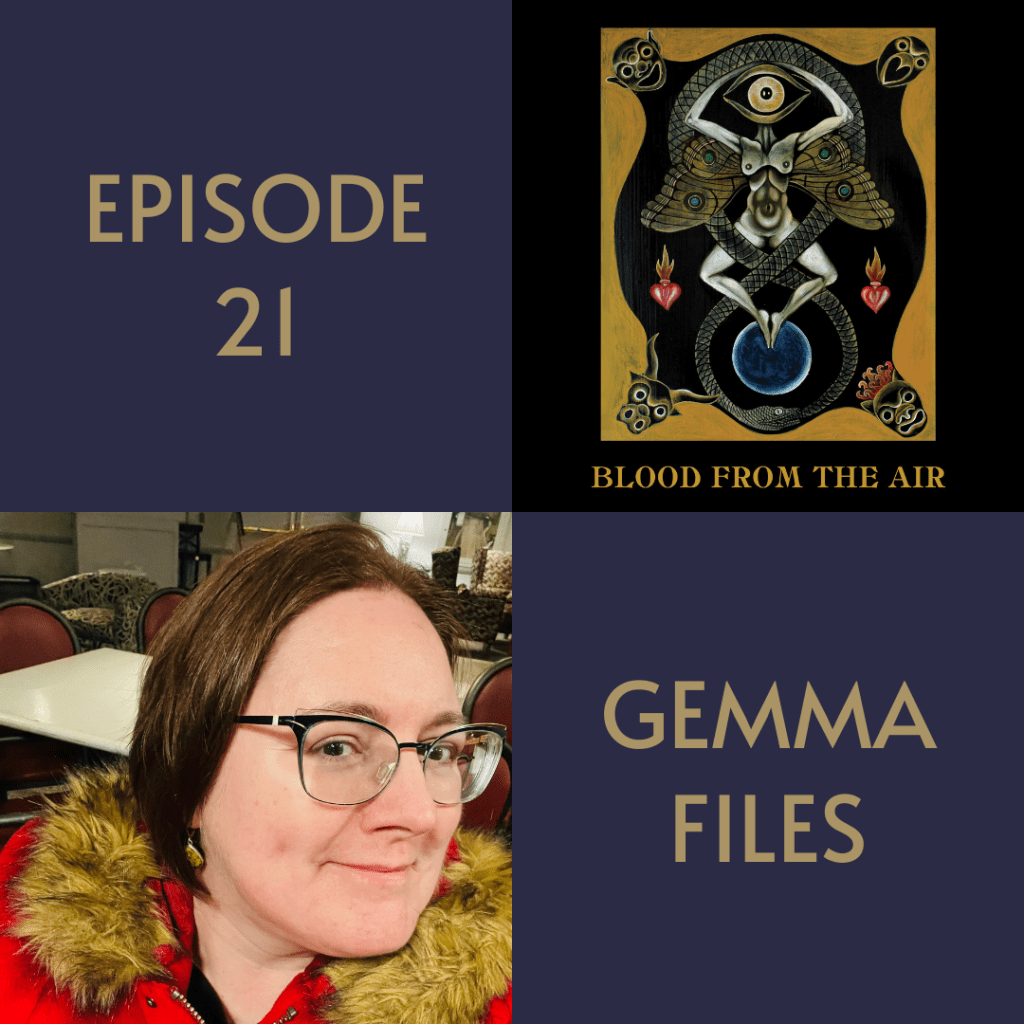
Craftwork Episode 21: Myth, Fetishism, & the Horror of Living in an Allistic World w/ Gemma Files

Listen to Craftwork Episode 21: Myth, Fetishism, & the Horror of Living in an Allistic World w/ Gemma Files.

In this interview, we chat with Gemma Files about horny monsters, Lovecraftian Airbnbs, the female gaze, and so much more.

Previously a film critic, journalist and teacher, Gemma Files has been an award-winning horror author since 1999. She’s best-known for her novel Experimental Film (Open Road Media) and her collections of short fiction, including the Bram Stoker Award-winning In That Endlessness, Our End and Blood From the Air (both from Grimscribe). Her next book, Little Horn: Stories, will be out in October from Shortwave. She is the autistic mother of an autistic son. For fun she sings, and doodles pretty monsters.

Books mentioned in this episode: 

  • Empire of the Sun – J. G. Ballard 
  • D’Aulaire’s Book of Greek MythsNorse Gods and Giants – Edgar Parin d’Aulaire and Ingri Parin d’Aulaire 
  • Black Flame – Gretchen Felker-Martin 
  • The Rotting Room – Viggy Parr Hampton 
  • Barrowbeck; The Loney; Starve Acre – Andrew Michael Hurley 
  • Bright Dead Star; Zoetrope Bizarre – Caitlín R. Kiernan 
  • The Jungle Book; The Second Jungle Book – Rudyard Kipling 
  • The Magician’s Nephew – C. S. Lewis 
  • The Reddening – Adam Nevill 
  • Metamorphoses – Ovid 
  • Cyrano de Bergerac – Edmond Rostand 
  • Frankenstein – Mary Shelley 
  • Dracula – Bram Stoker 
  • A Dark Matter – Peter Straub 
  • The Castle of Otranto – Horace Walpole 

Craftwork Episode 20: Girlhood, Defamiliarization, & Poetic Excavation w/ Emily Banks

Listen to Craftwork Episode 20: Girlhood, Defamiliarization, & Poetic Excavation w/ Emily Banks.

In this interview, we chat with Emily Banks about posthumous publications, linguistic allergies, the atomic nuts and bolts of imagery, and so much more. 

Emily Banks is the author of Mother Water (Lynx House Press, 2020). Her poems have appeared in PlumeCopper Nickel32 PoemsThe RumpusCutBankMid-American Review, and other journals. She publishes scholarship on American gothic literature, runs The Shirley Jackson Society, and is currently editing The Oxford Handbook of Shirley Jackson. She holds an MFA from the University of Maryland and a Ph.D. from Emory University. She lives in Indianapolis and teaches at Franklin College. 

Books, poems, and stories mentioned in this episode:

  • “Filling Station”; “In the Waiting Room” – Elizabeth Bishop
  • Alice’s Adventures in Wonderland – Lewis Carroll
  • Turn Up the Ocean – Tony Hoagland
  • “Dorothy and My Grandmother and the Sailors”; Hangsaman; The Haunting of Hill House; We Have Always Lived in the Castle – Shirley Jackson
  • Bliss Montage; Severance – Ling Ma
  • How to Do Nothing: Resisting the Attention Economy – Jenny Odell
  • Middle Distance – Stanley Plumly
  • Pamela – Samuel Richardson
  • Modern Poetry – Diane Seuss

Mike Thorn reviews Attack 13 [NYAFF ’25 In Review Online coverage]

Taweewat Wantha’s Attack 13 is unabashedly commercial entertainment — a horror movie made with the kind of cleanness, galloping pace, and pulsing score typical of much contemporary action cinema. However, within its mainstream parameters, it finds openings for some genuinely nasty imagery and social observation, and it creatively crossbreeds high school melodrama and supernatural horror conventions. 

Read the full review at In Review Online.

Craftwork Episode 19: Ghost Stories, Market Pressures, & Tapping into the Subconscious w/ Naben Ruthnum

Listen to Craftwork Episode 19: Ghost Stories, Market Pressures, & Tapping into the Subconscious w/ Naben Ruthnum.

In this interview, we chat with Naben Ruthnum about character development, avoiding TV-brained writing, making sense of first-reader notes, and so much more.

Naben Ruthnum is a Toronto-based writer of fiction, cultural criticism, film and TV. His novel A Hero of Our Time was released by Penguin Random House and was optioned for development by The Littlefield Company. His books include the YA novel The Grimmer, the World Fantasy Award-nominated horror novella Helpmeet and two thrillers penned as Nathan Ripley, both of which have been optioned for development and were published internationally. He has written for Canadian television series including Murdoch Mysteries and Cardinal. As a feature screenwriter, he’s collaborated with Kris Bertin for feature and TV projects in development at Oddfellows, BoulderLight Pictures, Automatik, Skybound, and Blink49. Kris and Naben’s script Road Test made the 2024 Black List.

Books mentioned in this episode:

  • A Clockwork Orange – Anthony Burgess
  • The Sorceress in Stained Glass & Other Ghost Stories – Richard Dalby, ed.
  • The Name of the Rose – Umberto Eco
  • The Black Dahlia; Killer on the Road; L.A. Confidential; My Dark Places – James Ellroy 
  • Black Flame – Gretchen Felker-Martin
  • The James Bond series – Ian Fleming
  • The Collector; The Magus – John Fowles
  • The Green Carnation – Robert Hichens
  • The Americans; The Tragic Muse; The Turn of the Screw – Henry James
  • Supernatural Horror in Literature – H. P. Lovecraft
  • The Beckoning Fair One – Oliver Onions
  • A Fatal Inversion; Master of the Moor – Ruth Rendell
  • Flicker – Theodore Roszak
  • The Tempest – William Shakespeare
  • Ghost Story; If You Could See Me Now; In the Night Room; Koko; The Throat – Peter Straub
  • The Secret History – Donna Tartt
  • A Dark-Adapted Eye; The House of Stairs – Barbara Vine
  • The October Film Haunt – Michael Wehunt

Create a website or blog at WordPress.com

Up ↑