“I think the central theme here is that we are peeling back the layers of society, and of humanity, to see what lies beneath – and it ain’t pretty.”
Author | Critic

“I think the central theme here is that we are peeling back the layers of society, and of humanity, to see what lies beneath – and it ain’t pretty.”


Submissions are now open for Monstrum 8.2, a special issue devoted to horror and ecohorror’s engagements with veganism and animal liberation. We seek proposals for essays (5,000-7,000 words) devoted to horror texts, modalities, and philosophies with a focus on veganism or animal rights.

Booklisti invited Mike Thorn to create a list. See his choices for Weirding the Gothic: Literary Horror Collisions.

I am continuing a new annual tradition. I’ve organized my choices chronologically, with externally and/or posthumously edited collections/anthologies at the end.
Vathek, an Arabian Tale; or, the History of the Caliph Vatek, by William Beckford (1786)
The Mysteries of Udolpho, by Ann Radcliffe (1794)
The Monk: A Romance, by Matthew Gregory Lewis (1796)
Wieland; or, The Transformation: An American Tale, by Charles Brockden Brown (1798)
Zofloya; or, the Moor, by Charlotte Dacre (1806)
Frankenstein; or, the Modern Prometheus, by Mary Shelley (1818)
Melmoth the Wanderer, by Charles Robert Maturin (1820)
The Private Memoirs and Confessions of a Justified Sinner, by James Hogg (1824)
Twice-Told Tales, by Nathaniel Hawthorne (1837)
The House of the Seven Gables, by Nathaniel Hawthorne (1851)
Carmilla, by J. Sheridan Le Fanu (1872)
Strange Case of Dr. Jekyll and Mr. Hyde, by Robert Louis Stevenson (1886)
The Picture of Dorian Gray, by Oscar Wilde (1890)
The Damned, by Joris-Karl Huysmans (1891)
The King in Yellow, by Robert W. Chambers (1895)
The Beetle, by Richard Marsh (1897)
Dracula, by Bram Stoker (1897)
The Invisible Man, by H. G. Wells (1897)
Ghost Stories of an Antiquary, by M. R. James (1904)
The Listener and Other Stories, by Algernon Blackwood (1907)
The House on the Borderland, by William Hope Hodgson (1908)
Pan’s Garden: A Volume of Nature Stories, by Algernon Blackwood (1912)
The Metamorphosis, by Franz Kafka (1915)
Ghosts, by Edith Wharton (1937)
The Subjugated Beast, by R. R. Ryan (1938)
Conjure Wife, by Fritz Leiber (1943)
The Hounds of Tindalos, by Frank Belknap Long (1946)
This Mortal Coil, by Cynthia Asquith (1947)
The Scarf, by Robert Bloch (1947 / 1966)
Hangsaman, by Shirley Jackson (1951)
The Bird’s Nest, by Shirley Jackson (1954)
I Am Legend, by Richard Matheson (1954)
The Sundial, by Shirley Jackson (1958)
The Breaking Point, by Daphne Du Maurier (1959)
The Haunting of Hill House, by Shirley Jackson (1959)
Shock!, by Richard Matheson (1961)
Something Wicked This Way Comes, by Ray Bradbury (1962)
We Have Always Lived in the Castle, by Shirley Jackson (1962)
The Collector, by John Fowles (1963)
The Sailor Who Fell from Grace with the Sea, by Yukio Mishima (1963)
Dark Entries, by Robert Aickman (1964)
New Stories from the Twilight Zone, by Rod Serling (1965)
I Have No Mouth & I Must Scream, by Harlan Ellison (1967)
Rosemary’s Baby, by Ira Levin (1967)
Last Summer, by Evan Hunter (1968)
The Obscene Bird of Night, by José Donoso (1970)
The Exorcist, by William Peter Blatty (1971)
The Room, by Hubert Selby Jr. (1971)
The Other, by Thomas Tryon (1971)
Burnt Offerings, by Robert Marasco (1973)
Child of God, by Cormac McCarthy (1973)
Carrie, by Stephen King (1974)
‘Salem’s Lot, by Stephen King (1975)
Julia, by Peter Straub (1975)
The Demon, by Hubert Selby Jr. (1976)
Interview with the Vampire, by Anne Rice (1976)
Long After Midnight, by Ray Bradbury (1976)
The Shining, by Stephen King (1977)
The House Next Door, by Anne Rivers Siddons (1978)
Blood Secrets, by Craig Jones (1978)
Strange Seed, by T. M. Wright (1978)
Ghost Story, by Peter Straub (1979)
Red Dragon, by Thomas Harris (1981)
The Woman in Black, by Susan Hill (1983)
Books of Blood: Volume One, by Clive Barker (1984)
The Ceremonies, by T. E. D. Klein (1984)
Hawksmoor, by Peter Ackroyd (1985)
The Damnation Game, by Clive Barker (1985)
The Juniper Tree, by Barbara Comyns (1985)
Songs of a Dead Dreamer, by Thomas Ligotti (1985)
Toplin, by Michael McDowell, (1985)
The Hungry Moon, by Ramsey Campbell (1986)
Beloved, by Toni Morrison (1987)
Why Not You and I?, by Karl Edward Wagner (1987)
The Fifth Child, by Doris Lessing (1988)
The Girl Next Door, by Jack Ketchum (1989)
The Pines, by Robert Dunbar (1989)
American Psycho, by Bret Easton Ellis (1991)
The Cipher, by Kathe Koja (1991)
Grimscribe: His Lives and Works, by Thomas Ligotti (1991)
Something Stirs, by Charles L. Grant (1991)
Bad Brains, by Kathe Koja (1992)
Skin, by Kathe Koja (1993)
The Between, by Tananarive Due (1995)
Zombie, by Joyce Carol Oates (1995)
Traplines, by Eden Robinson (1996)
Lunar Park, by Bret Easton Ellis (2005)
The Red Tree, by Caitlín R. Kiernan (2009)
Jack of Spades, by Joyce Carol Oates (2015)
Heartbreaker, by Maryse Meijer (2016)
Tender is the Flesh, by Agustina Bazterrica (2017)
And Her Smile Will Untether the Universe, by Gwendolyn Kiste (2017)
Strange is the Night, by S. P. Miskowski (2017)
The Seventh Mansion, by Maryse Meijer (2020)
We Are Here to Hurt Each Other, by Paula D. Ashe (2022)
Supplication, by Nour Abi-Nakhoul (2024)
Selected Writings of Edgar Allan Poe, by Edgar Allan Poe (1956) [edited by Edward H. Davidson]
Tales of H. P. Lovecraft, by H. P. Lovecraft (2007) [edited by Joyce Carol Oates]
Ghost Stories of Henry James, by Henry James (2008) [edited by Martin Schofield]
The Dark Eidolon and Other Fantasies, by Clark Ashton Smith (2014) [edited by S. T. Joshi]


Listen to Craftwork S1E12: Cruel Elegance, Cosmic Pessimism, & Rust Belt Vibes w/ Paula D. Ashe.
In this interview, we chat with Paula D. Ashe about writer’s block, narrative movement, urban legends, and so much more.
Paula D. Ashe (she/her) is an author of dark fiction. Her debut collection We Are Here to Hurt Each Other (Nictitating Books) was a Shirley Jackson Award winner for Single Author Collection and a Bram Stoker Award Finalist for Superior Achievement in a Fiction Collection. Recently, she received the Joseph S. Pulver Sr. Weird Fiction Award at NecronomiCon Providence. Paula was also an associate editor for Vastarien: A Literary Journal. She lives in the Midwest with her family.
Books and stories mentioned in this episode:


Listen to Craftwork S1E10: Weird Tales, Uncanny Dolls, & Creative Breakthroughs w/ Lisa Tuttle.
In this interview, we chat with Lisa Tuttle about genre history, the ideal protagonist, Harlan Ellison’s writing advice, and so much more.
Lisa Tuttle was born and raised in Austin, Texas, and moved to Britain in the 1980s. Her first novel, Windhaven, co-written with George R.R. Martin, was followed by over a dozen fantasy, science fiction, and horror novels, including three recent books set in the 1890s combining crime and supernatural fiction, featuring the detective duo Jasper Jesperson and Miss Lane; the third volume, The Curious Affair of the Missing Mummies, was published last year. She has also written hundreds of award-winning short stories collected in several volumes, including A Nest of Nightmares, The Dead Hours of the Night, and most recently, Riding the Nightmare. She is the author of The Encyclopedia of Feminism (1986) and currently writes a monthly science fiction review column for The Guardian. She lives with her husband and their daughter in Scotland.
Book and stories mentioned in this episode:

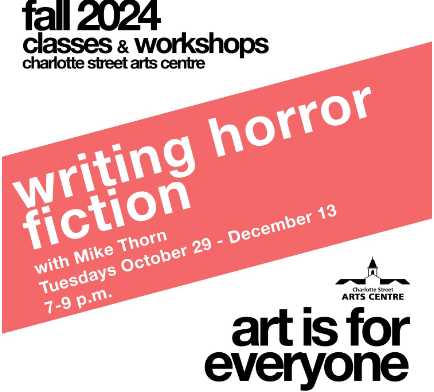
This course will engage with horror literature’s legacies and unique capacities for catharsis, allegory, and personal expression. We will discuss what scares us and investigate the psychology of fear within the context of fiction, digging into the nuts-and-bolts processes of generating fear in the reader. We will explore the wide range of horror’s subgenres and aesthetic possibilities, looking at tropes, traditions, and metaphors as opportunities for creative openings rather than restrictions. We will discuss the importance of atmosphere, point-of-view, and convincing characterization. Drawing on insights and fiction by some of horror literature’s most important and exciting figures, we will dive into the genre with a focus on craft and technique.
Date: Tuesdays, Oct. 29 – Dec. 3
Time: 7-9 p.m.
Location: Community Room (Charlotte Street Arts Centre)
Length: Six week
Cost: $15
Max. class size: 12

Listen to Craftwork S1E9: Eavesdropping, Travel Writing, & Glasgow Kisses w/ Mark Anthony Jarman.
In this interview, we chat with Mark Anthony Jarman about hockey fiction, deadwood words, finding stories in newspaper clippings, and so much more.
Mark Anthony Jarman is the author of Touch Anywhere to Begin, Czech Techno, Knife Party at the Hotel Europa, My White Planet, 19 Knives, New Orleans Is Sinking, Dancing Nightly in the Tavern, and the travel book Ireland’s Eye. Burn Man, published in 2023 by Biblioasis, was an Editors Choice with the New York Times. He was an acquisitions editor for Oberon Press, and introduced many new writers through the Coming Attractions series. He is also the editor of Best Canadian Stories 2023. His novel Salvage King Ya! is on Amazon.ca’s list of 50 Essential Canadian Books and is the number one book on Amazon’s list of best hockey fiction. Widely published in Canada, the US, Europe, and Asia, Jarman is a graduate of the Iowa Writers’ Workshop, a Yaddo fellow, has taught at the University of Victoria, the Banff Centre for the Arts, and the University of New Brunswick. He is also co-editor of the literary journal CAMEL.
Book and poems mentioned in this episode:

Listen to Craftwork S1E8: Obsession, Transgression, & the Library of Gestures w/ Maryse Meijer.
In this interview, we chat with Maryse Meijer about metaphor, quotation marks, the dubious necessity of author photos, and so much more.
Maryse Meijer is the author of Heartbreaker, Rag, Northwood, and The Seventh Mansion. She lives in Chicago.
Books and stories mentioned in this episode:
Author Photo Credit: Lewis McVey


In this interview, Craig Laurance Gidney talks about genre mashups, writing workshops, telling Mom which of your stories to avoid, and so much more.
Craig Laurance Gidney (he/him/his) is the author of Sea, Swallow Me & Other Stories; Skin Deep Magic: Stories; Bereft (a YA novella); and A Spectral Hue (a novel). He has been a Lambda Literary Finalist three times, was a Carl Brandon Parallax Award Finalist, and won the inaugural Joseph S. Pulver Sr. Award for Weird Fiction. The Nectar of Nightmares is his most recent collection. He lives in Washington, D.C.
Books and stories mentioned in this episode:
 Mike Thorn