
“Stand by Me finds its thematic core in the friendship between Gordie and Chris, who both perform masculine toughness to protect their mutually innate sensitivity.”
Author | Critic

“Stand by Me finds its thematic core in the friendship between Gordie and Chris, who both perform masculine toughness to protect their mutually innate sensitivity.”


Taweewat Wantha’s Attack 13 is unabashedly commercial entertainment — a horror movie made with the kind of cleanness, galloping pace, and pulsing score typical of much contemporary action cinema. However, within its mainstream parameters, it finds openings for some genuinely nasty imagery and social observation, and it creatively crossbreeds high school melodrama and supernatural horror conventions.


“Missing Child Videotape’s most significant virtues are in the intricacies of its folklore-steeped plot, which patiently unfolds with carefully administered moments of eerie revelation, especially surrounding the site of its central mystery.”


“Gothic cinema inherits an ongoing obsession with writers and writing from its literary ancestors, but how does it translate such text-based fixations into its own audiovisual grammar? How does it stage ‘objective’ diegeses in concert with the innately subjective representations of writers and the act of writing? This article approaches these questions, not by offering a comprehensive history of Gothic films depicting writers (that would require a long, book-length project), but by analyzing a trio of writer-focused Gothic films notable for their dealings with literary ancestry through negotiations between subjective interiority and diegetic objectivity.”


“Chime traffics in the ‘eerie’ titular concept of Mark Fisher’s The Weird and the Eerie: a kind of placid, almost subliminal detachment that Fisher argues ‘can give us access to the forces which govern reality but which are ordinarily obscured, just as it can give us access to spaces beyond mundane reality altogether.’ The chime, then, is an auditory metonym for the eerie, an experience that exceeds the visceral shock of horror to inhabit the more transcendent power of terror — 18th-century gothic novelist Ann Radcliffe defines these terms as two distinct phenomena: ‘Terror and horror are so far opposite, that the first expands the soul, and awakens the faculties to a high degree of life; the other contracts, freezes, and nearly annihilates them.’ In Chime, the high degree of life is the very thing that contracts, freezes, and annihilates.”

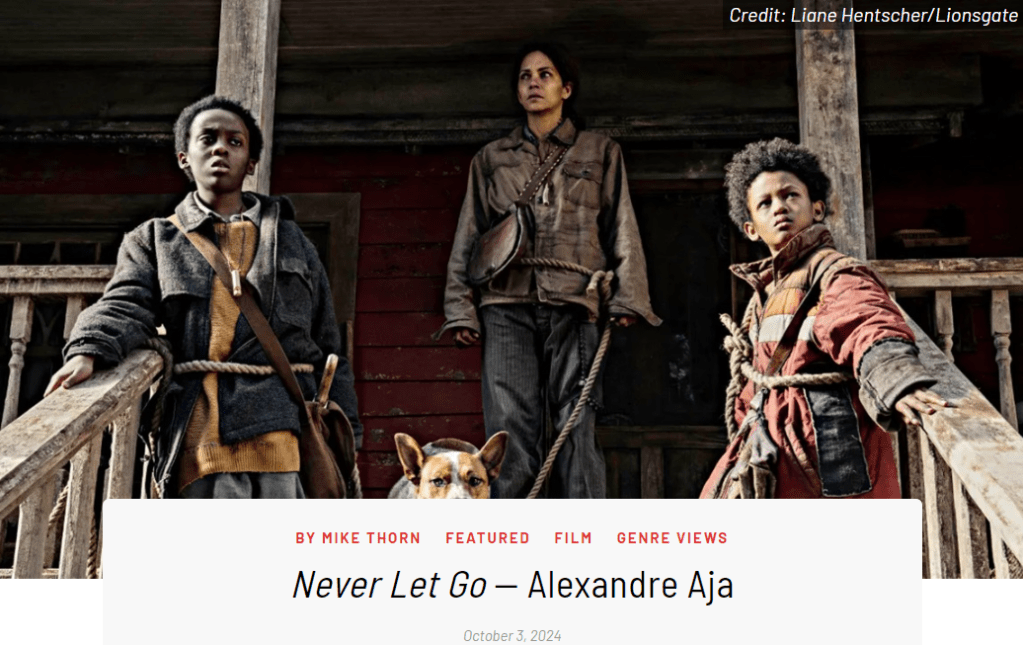
“Director Alexandre Aja’s latest film, Never Let Go, occupies a deliberately liminal space. Its threadbare plot suggests a post-apocalyptic near future, but its central family is stuck in a Gothic past.”


“Bustillo and Maury have demonstrated once again that horror contains multitudes, and it doesn’t need to play arthouse dress-up to indicate as much. Horror’s philosophical and aesthetic merits have always already been there: all one needs to do is look.”


“Sayuri makes overtures to the cultural anxieties underlying many haunted house narratives, with several lines pointedly alluding to what constitutes a ‘happy life.’ An early scene depicts a teacher asking her disinterested class to analyze a poem by posing questions such as ‘Where do we find happiness?’ and ‘What exactly is happiness?’ The film ultimately disavows the notion that domestic ownership equals anything like existential fulfillment or familial harmony. It locates horror in the conformist embrace of cultural repetitions, depicting its haunting as something like a tape stuck in a loop: the same ghostly giggle echoes through the house again and again, haunted TVs replay snippets of glitchy footage, and one character repeatedly watches the simulated reenactment of her beloved’s grisly death.”


“English computer scientist Tim Berners-Lee began dropping breadcrumbs toward the dark woods of the World Wide Web in 1989. He originally theorized the Web as a means of “universal access to a large universe of documents” that would combine three key components: hypertext, transmission control protocol, and a domain name system. His vision materialized in 1994, the “Year of the Web,” when websites began opening to the public. This development set the stage for the 21st century’s postmodern chaos — outsourced cognition leading to progress and disintegration in equal measures, facts and lies entangling in a collective frenzy of paranoia, rage, and disorientation.”


“The Canyons and The Counselor represent an America unmoored from its own self-aggrandizing mythologies — the capitalist dream as nightmare of anxiety and violence. The films are haunted by symbols rather than subjects, made nowhere clearer than in McCarthy’s naming The Counselor’s title protagonist (played by Michael Fassbender) after his profession — he is a nameless intermediary, a metaphor.”
 Mike Thorn