Craftwork S1E10: Weird Tales, Uncanny Dolls, & Creative Breakthroughs w/ Lisa Tuttle

Listen to Craftwork S1E10: Weird Tales, Uncanny Dolls, & Creative Breakthroughs w/ Lisa Tuttle.

In this interview, we chat with Lisa Tuttle about genre history, the ideal protagonist, Harlan Ellison’s writing advice, and so much more.

Lisa Tuttle was born and raised in Austin, Texas, and moved to Britain in the 1980s. Her first novel, Windhaven, co-written with George R.R. Martin, was followed by over a dozen fantasy, science fiction, and horror novels, including three recent books set in the 1890s combining crime and supernatural fiction, featuring the detective duo Jasper Jesperson and Miss Lane; the third volume, The Curious Affair of the Missing Mummies, was published last year. She has also written hundreds of award-winning short stories collected in several volumes, including A Nest of NightmaresThe Dead Hours of the Night, and most recently, Riding the Nightmare. She is the author of The Encyclopedia of Feminism (1986) and currently writes a monthly science fiction review column for The Guardian. She lives with her husband and their daughter in Scotland.

Book and stories mentioned in this episode:

  • The Saint of Bright Doors – Vajra Chandrasekera
  • Shirley Jackson: A Rather Haunted Life – Ruth Franklin
  • HangsamanThe Haunting of Hill House; “The Lottery” – Shirley Jackson
  • The MANIACWhen We Cease to Understand the World – Benjamín Labatut
  • Biography of X – Catherine Lacey
  • The Seventh Mansion – Maryse Meijer
  • BabysitterBy the North GateTheyThe Wheel of Love – Joyce Carol Oates
  • The Bell Jar – Sylvia Plath
  • Lake of Darkness – Adam Roberts
  • CryptonomiconPolostan – Neal Stephenson

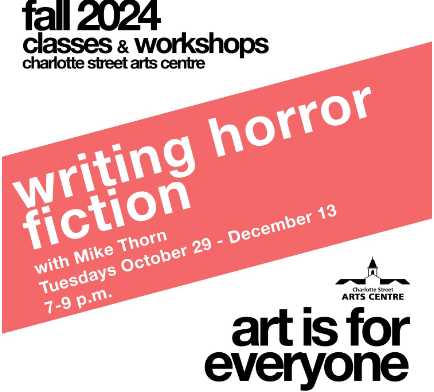
Writing Horror Fiction with Mike Thorn (upcoming workshop course with the Charlotte Street Arts Centre)

This course will engage with horror literature’s legacies and unique capacities for catharsis, allegory, and personal expression. We will discuss what scares us and investigate the psychology  of fear within the context of fiction, digging into the nuts-and-bolts processes of generating fear  in the reader. We will explore the wide range of horror’s subgenres and aesthetic possibilities,  looking at tropes, traditions, and metaphors as opportunities for creative openings rather than  restrictions. We will discuss the importance of atmosphere, point-of-view, and convincing  characterization. Drawing on insights and fiction by some of horror literature’s most important  and exciting figures, we will dive into the genre with a focus on craft and technique. 

Date: Tuesdays, Oct. 29 – Dec. 3
Time: 7-9 p.m.
Location: Community Room (Charlotte Street Arts Centre)
Length: Six week
Cost: $15
Max. class size: 12

Registration now open.

Mike Thorn reviews House of Sayuri (In Review Online)

Sayuri makes overtures to the cultural anxieties underlying many haunted house narratives, with several lines pointedly alluding to what constitutes a ‘happy life.’ An early scene depicts a teacher asking her disinterested class to analyze a poem by posing questions such as ‘Where do we find happiness?’ and ‘What exactly is happiness?’ The film ultimately disavows the notion that domestic ownership equals anything like existential fulfillment or familial harmony. It locates horror in the conformist embrace of cultural repetitions, depicting its haunting as something like a tape stuck in a loop: the same ghostly giggle echoes through the house again and again, haunted TVs replay snippets of glitchy footage, and one character repeatedly watches the simulated reenactment of her beloved’s grisly death.”

Read the full review at In Review Online.

Craftwork S1E8: Obsession, Transgression, & the Library of Gestures w/ Maryse Meijer

Listen to Craftwork S1E8: Obsession, Transgression, & the Library of Gestures w/ Maryse Meijer.

In this interview, we chat with Maryse Meijer about metaphor, quotation marks, the dubious necessity of author photos, and so much more.

Maryse Meijer is the author of Heartbreaker, Rag, Northwood, and The Seventh Mansion. She lives in Chicago.

Books and stories mentioned in this episode:

  • Samuel Beckett: A Biography – Deirdre Bair
  • Waiting for Godot – Samuel Beckett
  • About Schmidt – Louis Begley
  • Autobiography of Red – Anne Carson
  • New Grub Street – George Gissing
  • The Children of the Dead; Greed; The Piano Teacher – Elfriede Jelinek
  • Pet Sematary – Stephen King
  • Bad Brains; The Cipher; Kink; Skin; Strange Angels – Kathe Koja
  • The Communicating Vessels – Friederike Mayröcker 
  • All the Pretty Horses – Cormac McCarthy
  • Hurricane Season; Paradais – Fernanda Melchor
  • The Defense; Lolita – Vladimir Nabokov
  • Black Water; Blonde; Heat; My Sister, My Love; “Where Are You Going, Where Have You Been?”; Zombie – Joyce Carol Oates
  • With the Animals – Noëlle Revaz
  • Snake Eyes – Rosamond Smith
  • The Custom of the Country – Edith Wharton

Author Photo Credit: Lewis McVey

Craftwork S1E7: Weird Angels, Maximalism, & the Taste of Prose w/ Craig Laurance Gidney

Listen to Craftwork Episode 7: Weird Angels, Maximalism, & the Taste of Prose w/ Craig Laurance Gidney.

In this interview, Craig Laurance Gidney talks about genre mashups, writing workshops, telling Mom which of your stories to avoid, and so much more.

Craig Laurance Gidney (he/him/his) is the author of Sea, Swallow Me & Other StoriesSkin Deep Magic: StoriesBereft (a YA novella); and A Spectral Hue (a novel). He has been a Lambda Literary Finalist three times, was a Carl Brandon Parallax Award Finalist, and won the inaugural Joseph S. Pulver Sr. Award for Weird Fiction. The Nectar of Nightmares is his most recent collection. He lives in Washington, D.C.

Books and stories mentioned in this episode:

  • The Handmaid’s Tale – Margaret Atwood
  • Giovanni’s RoomGo Tell It on the MountainIf Beale Street Could Talk  – James Baldwin
  • Jonathan Strange & Mr. NorrellPiranesi – Susanna Clarke
  • Dhalgren – Samuel R. Delany
  • The Corrections – Jonathan Franzen
  • The Uncanny – Sigmund Freud
  • A Ring of Endless LightA Wrinkle in Time – Madeleine L’Engle
  • Black Light – Elizabeth Hand
  • The Complete Tales of Uncle Remus – Joel Chandler Harris
  • “The Golden Pot”; “The Sandman” – E. T. A. Hoffmann
  • Finnegan’s Wake – James Joyce
  • “Josephine the Singer, or the Mouse Folk” – Franz Kafka
  • Delirium’s Mistress – Tanith Lee
  • “The Outsider”; “The Rats in the Walls” – H.P. Lovecraft
  • The Winds of Winter – George R. R. Martin
  • The Starless Sea – Erin Morgenstern
  • Tar Baby – Toni Morrison
  • “A Good Man is Hard to Find” – Flannery O’Connor
  • Corpsepaint – David Peak
  • Queen of Teeth – Hailey Piper

“World Wide Web of Dread: Horror from the Year of the Web, 30 Years Later” (In Review Online)

“English computer scientist Tim Berners-Lee began dropping breadcrumbs toward the dark woods of the World Wide Web in 1989. He originally theorized the Web as a means of “universal access to a large universe of documents” that would combine three key components: hypertext, transmission control protocol, and a domain name system. His vision materialized in 1994, the “Year of the Web,” when websites began opening to the public. This development set the stage for the 21st century’s postmodern chaos — outsourced cognition leading to progress and disintegration in equal measures, facts and lies entangling in a collective frenzy of paranoia, rage, and disorientation.”

Read the full article.

Create a website or blog at WordPress.com

Up ↑