Kristi DeMeester Explores Everything That’s Underneath Social Norms, Consciousness, and Reality


Kristi DeMeester’s Everything That’s Underneath reads something like a creative thesis on horror fiction’s inherently allegorical potential. The story’s title speaks to the collection’s persisting concerns. Namely, the book faces the menace undergirding polite society, and the unseen specters clawing at the outskirts of consciousness, even of reality itself (consider, for example, the title story, “Birthright,” and “Split Tongues”).

The author navigates lived-in, conflicted protagonists through plots whose threats are often shapeshifting, amorphous, and inscrutable. DeMeester demonstrates a mastery of withholding detail while doling out just enough information to pry her way under the reader’s skin. This is one of the most difficult tasks the horror writer faces: if we show too much, we risk deflating the tension, but if we show too little, we might seem like we’re bluffing or shying away from the dark stuff. DeMeester never misses the mark in this regard, depicting horrific presences that push against the thin membrane separating reality and that which is underneath.

The book displays an extremely impressive knack for character psychology, using heightened sensory experiences and drives as catalysts to confront supernatural forces. Consider the characters’ sexual lust propelling the narratives in “The Fleshtival,” “Daughters of Hecate,” and “Split Tongues,” or the yearning to undo loss in the title story and “To Sleep in the Dust of the Earth.” DeMeester is unflinching in her exploration of her characters’ desires, which lends itself to a convincing sense of realism in their motivations and actions.

Driven by challenging thematic interests and a stunning prose style, this book ranks among the best dark fiction collections of the past ten years. Think S. P. Miskowski, Gwendolyn Kiste, Kathe Koja … yes, DeMeester is that good. This is the work of a major talent, and an absolute must-read for anyone interested in contemporary weird fiction.

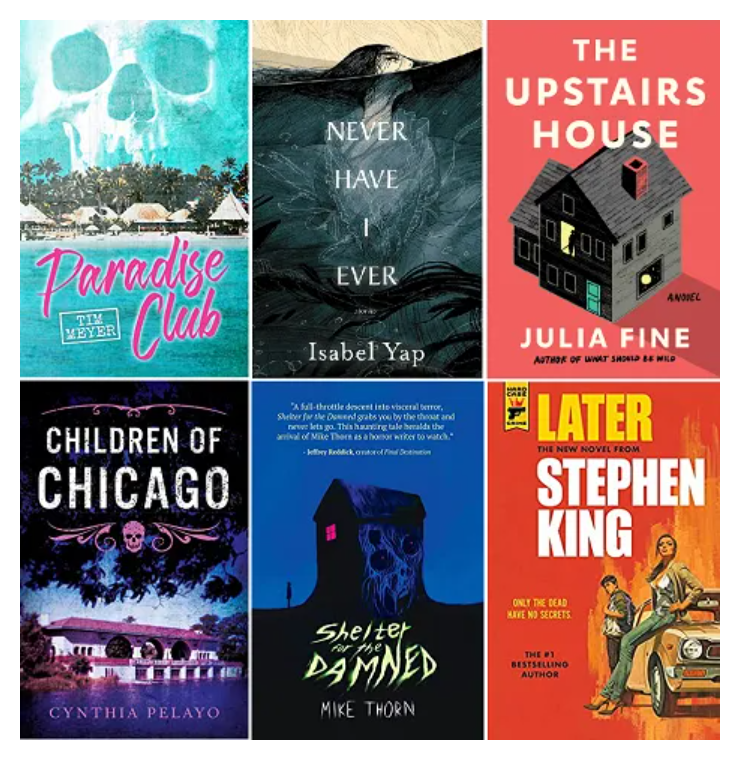
Shelter for the Damned Included on Read by Dusk’s 30 Most Anticipated Horror Books of 2021

“Are you ready for 2021? I am!

While 2020 has been a hellfire, fortunately the quality of horror fiction remained excellent. There were plenty of fantastic horror books released this year and I hope they entertained you, or at least took your mind off your worries for a while.

So looking ahead to 2021, I have compiled a list of the most anticipated horror books coming soon! To make it simple, I chose the ones that already have a cover and publication date.”

Check out the full list.

Beyond the Book of Eibon: A literary tribute to Lucio Fulci

I’m thrilled to announce that my new story “Offer to the Adversary” will be included in Beyond the Book of Eibon, a literary tribute anthology to the Italian horror master, Lucio Fulci! 

Secure your copy on Kickstarter.

Edited by Perry Ruhland and Astrid Rose, the book will also include contributions by Adam Cesare, Gemma Files, Orrin Grey, Michael Hoarty, Kai Perrignon, Matt Serafini, William Tea, Christopher Slatsky, and others. Featuring a foreword by Kier-La Janisse.

Dark Updates (for Better and Worse): Darkest Hours & Shelter for the Damned

It seems only yesterday that I unleashed my debut short story collection Darkest Hours on the world. November 10, 2020 will mark its three-year anniversary, and the end of its print run with Unnerving. So far, the book has been thriving thanks to support and enthusiasm from readers, reviewers, and horror enthusiasts from all dark corners. I fully intend to find it an excellent new home, and I will provide updates as they come!

Having said that, if you want to pick up a copy of Darkest Hours, now is absolutely the time. Order from Amazon or Barnes & Noble before it vanishes (for now…).

In other news, my debut novel Shelter for the Damned is scheduled for release with JournalStone on February 26, 2021. I have a lot of exciting updates related to that project, but I’m going to have to sit on those for the time being.

Here’s the synopsis:

While looking for a secret place to smoke cigarettes with his two best friends, troubled teenager Mark discovers a mysterious shack in a suburban field. Alienated from his parents and peers, Mark finds within the shack an escape greater than anything he has ever experienced.

But it isn’t long before the place begins revealing its strange, powerful sentience. And it wants something in exchange for the shelter it provides. 

Stay spooky, my friends! More updates soon…

The Weird Delights of Daniel Braum’s Underworld Dreams

Cover Reveal: Underworld Dreams by Daniel Braum – Ink Heist
Lethe Press, 2020

Daniel Braum’s new short story collection Underworld Dreams comes equipped with a Story Notes section; within these Notes, the author provides thoughtful reflections on his creative process, narrative intentions, and philosophical interests, among other things. Most prominently, Braum stresses his persisting interest in the ambiguous space between the psychological and the supernatural. Braum’s fiction inhabits this space and engages with the Weird tradition to depict our reality as innately interstitial, slippery, and impervious to “mastery.” By extension, Underworld Dreams repeatedly encourages us to scrutinize the artificial gap between human and nonhuman animals, between subject and world.

This coy, quiet, and unassuming challenge to human exceptionalism resonates throughout. The first story, “How to Stay Afloat When Drowning,” features a disturbing centerpiece in which a group of people brutally torture a shark; later, the story uses its psychological-supernatural ambiguity to blur the distinction between shark and human. “The Monkey Coat” lends attention to the suffering bound up in its titular object (the origin of whose horrors remain unknown).

Braum does not employ this symbolism to bluntly didactic ends; rather, he assesses the artificial divide between human and nonhuman animal to underline broader investigations about the human subject’s relation to the world. For example, the title story sees characters discussing acts of infidelity and dishonesty as reflections of their “monkey in the jungle” selves.

Braum cites Algernon Blackwood’s classic Weird novella The Willows in his Story Notes, and the imprint is visible: Underworld Dreams repeatedly sees its characters encountering eerily numinous spaces and reality-fissures in environments that have evaded global industrialism. Braum finds lots of potential for the ineffable in “natural” spaces, demonstrating a knack for imagery and atmosphere.

There are horrifying moments here (perhaps most notably in the aforementioned “Monkey Coat,” reportedly inspired by advice Braum got from the legendary Jack Ketchum), but this book mostly occupies Weird Fiction’s less macabre terrain. China Melville writes that the “obsession with numinosity under the everyday is at the heart of Weird Fiction,” and this is the obsession that most clearly characterizes Underworld Dreams. For readers seeking fiction with a strong narrative engine and a bold commitment to the unknown, this collection is one to seek out.

Farah Rose Smith Interviews Mike Thorn on The Eldritch Index

einterview

Was there a pivotal moment when you decided to be a writer?

I can’t remember a time before I started writing. For better or worse, it has been a lifelong impulse. I was always drawn to reading, which is probably where my interest in writing originated. As a kid, I was excited by fantasy and horror (J. R. R. Tolkien, C. S. Lewis and R. L. Stine when I was quite young, and then Stephen King when I got a little older).”

Read the full interview here.

Create a website or blog at WordPress.com

Up ↑