What do you desire from the natural world? For millions of years, we’ve been shaped and reshaped by the environment around us. If technology has the power to mimic lush lands and blue waters, how do we bond if we can’t tell what is real or not—or worse, does it even matter? In this issue, we journey through galaxies where love knows no bounds, nature that heals, wild hearts to be untamed, plants that lust.
In this interview, we chat with Lisa Tuttle about genre history, the ideal protagonist, Harlan Ellison’s writing advice, and so much more.
Lisa Tuttle was born and raised in Austin, Texas, and moved to Britain in the 1980s. Her first novel, Windhaven, co-written with George R.R. Martin, was followed by over a dozen fantasy, science fiction, and horror novels, including three recent books set in the 1890s combining crime and supernatural fiction, featuring the detective duo Jasper Jesperson and Miss Lane; the third volume, The Curious Affair of the Missing Mummies, was published last year. She has also written hundreds of award-winning short stories collected in several volumes, including A Nest of Nightmares, The Dead Hours of the Night, and most recently, Riding the Nightmare. She is the author of The Encyclopedia of Feminism (1986) and currently writes a monthly science fiction review column for The Guardian. She lives with her husband and their daughter in Scotland.
Book and stories mentioned in this episode:
The Saint of Bright Doors – Vajra Chandrasekera
Shirley Jackson: A Rather Haunted Life – Ruth Franklin
Hangsaman; The Haunting of Hill House; “The Lottery” – Shirley Jackson
The MANIAC; When We Cease to Understand the World – Benjamín Labatut
Biography of X – Catherine Lacey
The Seventh Mansion – Maryse Meijer
Babysitter; By the North Gate; They; The Wheel of Love – Joyce Carol Oates
In this interview, Craig Laurance Gidney talks about genre mashups, writing workshops, telling Mom which of your stories to avoid, and so much more.
Craig Laurance Gidney (he/him/his) is the author of Sea, Swallow Me & Other Stories; Skin Deep Magic: Stories; Bereft (a YA novella); and A Spectral Hue (a novel). He has been a Lambda Literary Finalist three times, was a Carl Brandon Parallax Award Finalist, and won the inaugural Joseph S. Pulver Sr. Award for Weird Fiction. The Nectar of Nightmares is his most recent collection. He lives in Washington, D.C.
Books and stories mentioned in this episode:
The Handmaid’s Tale – Margaret Atwood
Giovanni’s Room; Go Tell It on the Mountain; If Beale Street Could Talk – James Baldwin
Jonathan Strange & Mr. Norrell; Piranesi – Susanna Clarke
Dhalgren – Samuel R. Delany
The Corrections – Jonathan Franzen
The Uncanny – Sigmund Freud
A Ring of Endless Light; A Wrinkle in Time – Madeleine L’Engle
Black Light – Elizabeth Hand
The Complete Tales of Uncle Remus – Joel Chandler Harris
“The Golden Pot”; “The Sandman” – E. T. A. Hoffmann
Finnegan’s Wake – James Joyce
“Josephine the Singer, or the Mouse Folk” – Franz Kafka
Delirium’s Mistress – Tanith Lee
“The Outsider”; “The Rats in the Walls” – H.P. Lovecraft
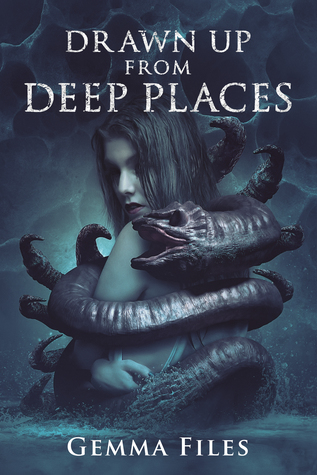
It is fascinating to assess Gemma Files’ Drawn Up from Deep Places as a collection, because the book’s construction is so uniquely connective. That is, rather than reading as an assortment of individual, isolated pieces, Drawn Up from Deep Places registers as a carefully designed, cumulative whole, comprised of two re-emerging fictional sequences woven among several standalone stories. With this text, Files displays extraordinary thoughtfulness and craft, both in conceptual and formal terms.
The collection begins with the vivid, haunting “Villa Locusta,” which situates us in an apocalyptic environment laden with mythological and religious imagery. Files further demonstrates her penchant for religious allusion with “Sown from Salt” and its companion story, “A Feast for Dust”: this duo recalls Clint Eastwood’s High Plains Drifter, injecting a somber Western narrative with Biblical and supernatural reflections.
The bulk of the collection is devoted to another ambitious, genre-crossing series of interconnected tales. These pieces (“Trap-Weed,” “Two Captains,” the title story, and the final novelette, “The Salt Wedding”) revolve around a toxic, queer, and (sometimes dangerously) magic pirate romance aboard a ship named the Bitch of Hell.
There is also a queer horror-Western populated with demonic zombies (“Satan’s Jewel Crown”), a dark, culturally-specific love story with supernatural threads (“Hell Friend”), and an assembly of screenplay-formatted tableaus set around Jack the Ripper (“Jack-Knife,” definitely my favorite). With “Jack-Knife,” Files draws adeptly on her cinephilia and film criticism background, designing a narrative that reads both thrillingly as prose fiction and convincingly as visual text.
Drawn Up from Deep Places showcases a highly talented writer who inhabits rich genre histories and always manages to reconfigure those traditions in unusual, interesting ways. Files demonstrates stunning formal dexterity here, and a total command of voice (I am in awe of the sheer range of approaches here). This is a collection meant to be consumed as a whole, carefully designed and artfully executed. Highly recommended to adventurous readers of genre fiction.


 Mike Thorn