
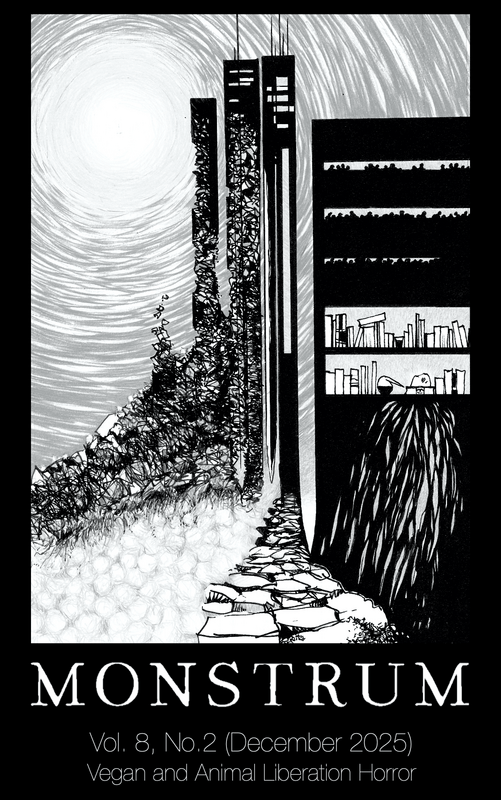
Monstrum vol. 8, issue 2 is now available!
Guest-edited by horror scholar and fiction writer Mike Thorn, this robust issue presents six feature essays, two works of original fiction, a dossier of retrospective reviews, and two essays in our student forum. Feature essays cover both literature and the moving image from a broad range of perspectives. From reorienting human and more-than-human animal perspectives in the essays by Poulomi Choudhury, Dru Jeffries, and Britt MacKenzie-Dale, to epistemological and ontological shifts in the way we think of human and more than-human ecologies in the essays by Zoë Anne Laks, Jenni Makahnouk, and William Taylor, and the Introduction by Mike Thorn, the contributions to this special issue explore the challenge of thinking beyond harmful anthropocentric and hegemonic capitalist world systems.
For the first time, this issue of Monstrum includes original fiction. In “The Playground,” celebrated horror author Kathe Koja (The Cipher, Under the Poppy, Straydog) traces a shift in ecological sensibility to what might be called a necessary violence. And with “Cogno,” Mike Thorn (Darkest Hours, Peel Back and See) brings us into the terrifying world of tech-bro longevity at the expense of … maybe everything.
A selection of retrospective reviews considers literary and cinematic texts that strive to reorient human and nonhuman animal perspectives, including a critical reassessment of the (anti-)anthropocentrism in Nobel laureate Olga Tokarczuk’s novel Drive Your Plow Over the Bones of the Dead (2018), the vegan aesthetic of Rob Zombie’s films via House of 1000 Corpses (2003), and the brutal struggle against becoming-animal in Stuart Gordon’s grim King of the Ants (2003).
The student forum includes two essays by emerging scholars that continue the issue’s investigations of radical otherness. A product of the SSHRC-funded “Horror Ecologies” workshop by CORERISC held in summer 2024 at Dawson College, Emerson Reault’s essay reads Ginger Snaps as a trans allegory, reconsidering the film’s metaphorical “curse” as less one of becoming a woman, than that of an understanding of one’s embodiment. In their essay, Luka Romney looks at radical empathy for the “animal” Other via Julia Kristeva’s concept of herethics in two of Larry Cohen’s most provocative 1970s films, It’s Alive! (1976) and It Lives Again (1978).
 Mike Thorn