
“Stand by Me finds its thematic core in the friendship between Gordie and Chris, who both perform masculine toughness to protect their mutually innate sensitivity.”
Author | Critic

“Stand by Me finds its thematic core in the friendship between Gordie and Chris, who both perform masculine toughness to protect their mutually innate sensitivity.”


“Sayuri makes overtures to the cultural anxieties underlying many haunted house narratives, with several lines pointedly alluding to what constitutes a ‘happy life.’ An early scene depicts a teacher asking her disinterested class to analyze a poem by posing questions such as ‘Where do we find happiness?’ and ‘What exactly is happiness?’ The film ultimately disavows the notion that domestic ownership equals anything like existential fulfillment or familial harmony. It locates horror in the conformist embrace of cultural repetitions, depicting its haunting as something like a tape stuck in a loop: the same ghostly giggle echoes through the house again and again, haunted TVs replay snippets of glitchy footage, and one character repeatedly watches the simulated reenactment of her beloved’s grisly death.”


“If The Way of Water is a crucial work of tech Romanticism, then another of its richest central dissonances is that between past and future: it imagines a world that stands a chance against modernity’s most brutal and oppressive machinations, thus situating itself in the past, but it also uses its genre modality to speculate a future that exceeds postmodernity’s politically flattening failures.”


With the 2019 release of Inside the Castle, Josiah Morgan announced himself as a transgressive and exciting new voice, and Circles is further evidence. A freewheeling blur of poetry, film criticism, and visual art, Morgan’s latest work urges its readers to question what defines a text, and even what it means to read. Morgan pursues these complex problems through the attentive and varied use of typography, offering a mixture of blank-verse, concrete poetry, and essay fragments that gesture to the book’s title shape and its implications of auto-cannibalism and endlessness.
The content is as fascinating and rebellious as the form. Morgan draws on disparate media, religious references, and allusions both coded and explicit (I was particularly pleased to see one of my favorite lines from Elizabeth Bishop’s “One Art,” and a reading of the vegan ethos in Tobe Hooper’s The Texas Chain Saw Massacre). The author lays bare his frame of references in an appendix labeled ASSISTANCE [IN RESEARCH AND ERASURE], and his array of sources is fascinating and unique.
The result is not nearly as daunting or unapproachable as it might sound. In fact, I easily devoured the book in one quick sitting. Morgan’s work is energizing, animated by a vital and authentic voice, threaded with both coldly ironic observation and real despair. The author engages in some hilarious interplay between artificial designations of “high” and “low” art. Consider, for example, a prose-poem near the end of the book that describes a speaker masturbating to urolagniac fantasies of shock-punk icon GG Allin before reading Verlaine, Rimbaud, and Plath.
Much like Morgan’s excellent Inside the Castle, Circles is a powerful testament to this brilliant young writer’s talent. Keep your eyes on him.


“Given its distilled concentration of elements, its fierce reworking of pop sensibility, and its placement within the band’s trajectory, Screaming for Vengeance feels something like metal’s answer to Pet Sounds.”


I wrote about Rob Zombie’s 2010s cinematic output for In Review Online. I discuss problems of solipsism in contemporary genre scholarship, Zombie as renegade anti-humanist, and more.


Coming October 31 from The Seventh Row: Beyond Empowertainment: Feminist Horror and the Struggle for Agency. Discover some of the best female-centred horror films of the decade and how they’re pushing the genre forward.
The collection features Mike Thorn’s essay “‘No Desire If It’s Not Forbidden’: Dread, Eroticism, and Text Messaging in Personal Shopper,” an interview with Personal Shopper director Olivier Assayas, and contributions by Orla Smith, Elena Lazic, and Mary Angela Rowe, among others.


Mike Thorn reviewed Niall Howell’s debut novel Only Pretty Damned for FreeFall Magazine (volume 29, no. 2).

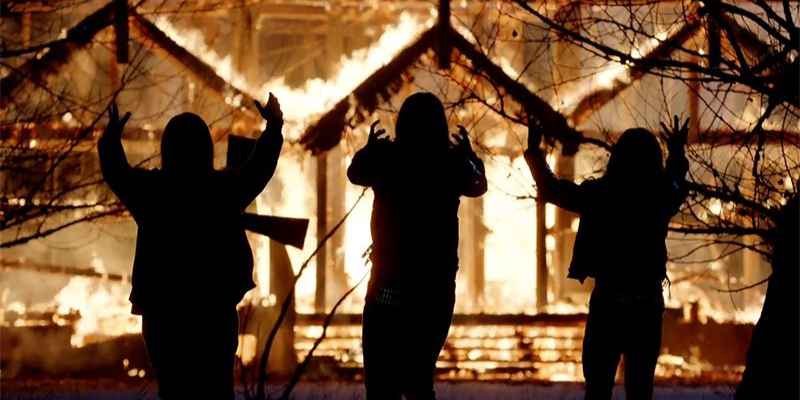
I had a good time discussing Lords of Chaos with Andrew Swafford for Cinematary. Among other things, we delved into the film’s dealings with black metal, representation vs. reality and fascism. Check it out.
 Mike Thorn