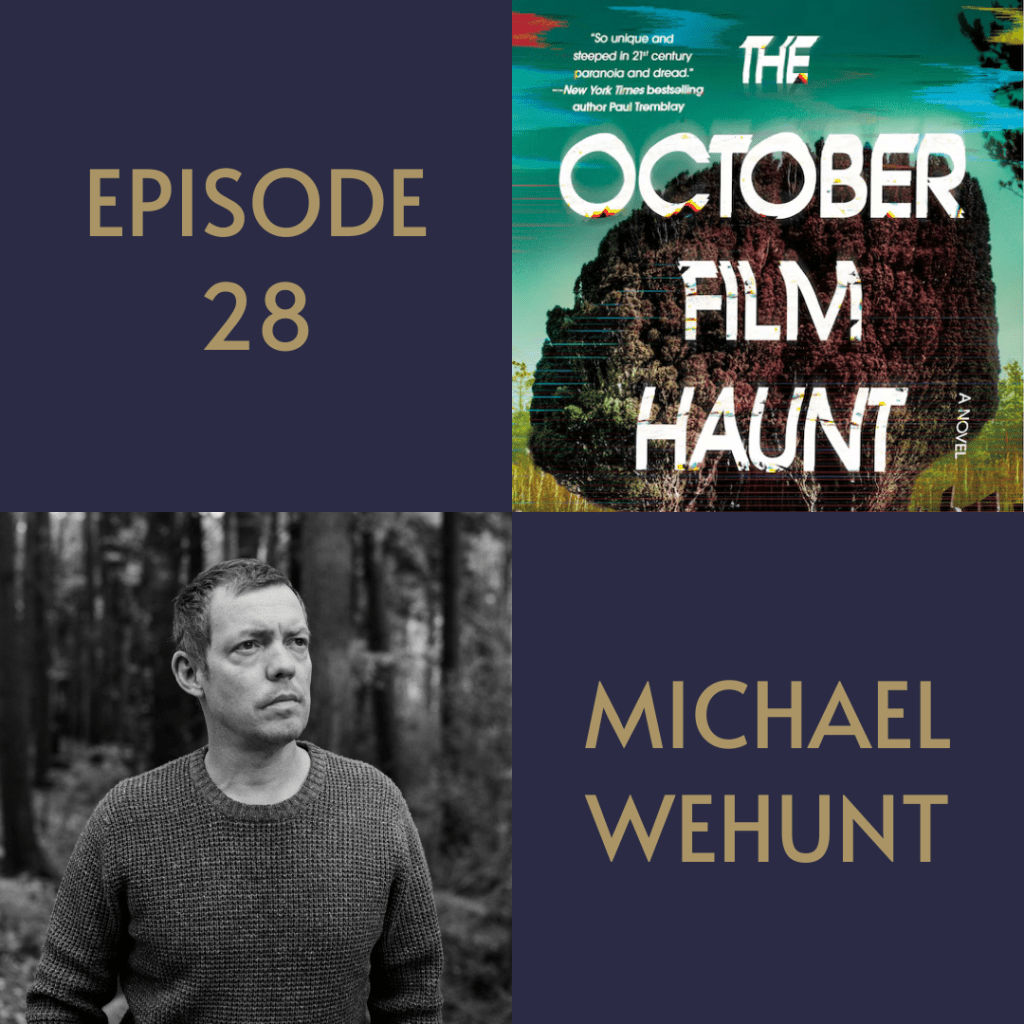
In this interview, we chat with Michael Wehunt about the administrative side of professional writing, the unanticipated weirdness of public selfhood, the “moment before the moment”, and so much more.
Michael Wehunt has been a finalist for the Bram Stoker Award, multiple Shirley Jackson Awards, and the International Association for the Fantastic in the Arts’ Crawford Award. In Spain, his translated works have garnered nominations for the Premio Ignotus and Premio Amaltea, winning the latter. He haunts the woods of Decatur, Georgia, with his partner and their dog. Together, they hold the horrors at bay. Most recently, he is the author of the novels The October Film Haunt and Nightjars.
Books and poems mentioned in this episode:
Ancient Images; The Grin of the Dark; Incarnate — Ramsey Campbell
Generation X: Tales for an Accelerated Culture — Douglas Coupland
Poems 1962-2020 — Louise Glück
Carrie — Stephen King
Beings — Ilana Masad
The God of the Woods; Long Bright River — Liz Moore
Northanger Abbey, by Jane Austen (1817) The Moonstone, by Wilkie Collins (1868) The Island of Dr. Moreau, by H. G. Wells (1896) What Maisie Knew, by Henry James (1897; 1908 New York Edition) The House of Souls, by Arthur Machen (1906) Widdershins, by Oliver Onions (1911) Summer, by Edith Wharton (1917) Tales of the Jazz Age, by F. Scott Fitzgerald (1922) The Maltese Falcon, by Dashiell Hammett (1930) Strangers on a Train, by Patricia Highsmith (1950) The Nothing Man, by Jim Thompson (1954) A Severed Head, by Iris Murdoch (1961) Aura, by Carlos Fuentes (1962) Slouching Towards Bethlehem, by Joan Didion (1968) Sula, by Toni Morrison (1973) The Coherence of Gothic Conventions, by Eve Kosofsky Sedgwick (1980) Bad Behavior, by Mary Gaitskill (1988) Ancient Images, by Ramsey Campbell (1989) Blonde, by Joyce Carol Oates (2000) Border Crossing, by Pat Barker (2001) These Truths: A History of the United States, by Jill Lepore (2018) The Best of Both Worlds, by S. P. Miskowski (2020) Hi, It’s Me, by Fawn Parker (2024) Dark Matter, by Kathe Koja (2025) Wreckage / What Happens in Hello Jack, by Peter Straub (2025)
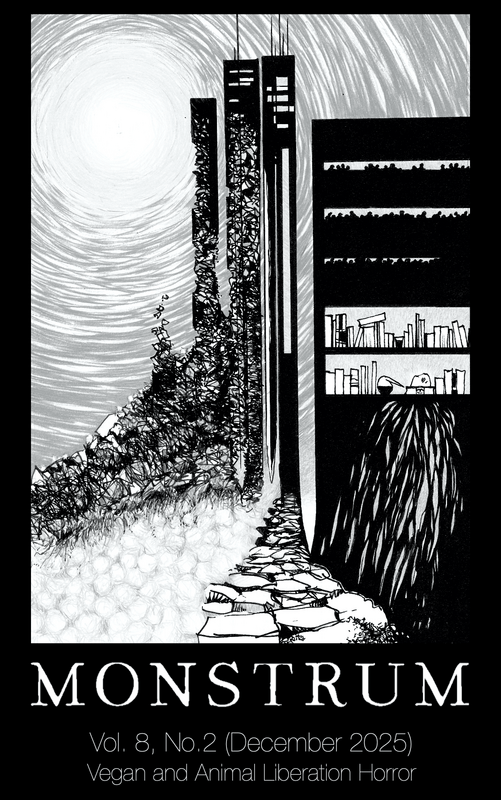
Guest-edited by horror scholar and fiction writer Mike Thorn, this robust issue presents six feature essays, two works of original fiction, a dossier of retrospective reviews, and two essays in our student forum. Feature essays cover both literature and the moving image from a broad range of perspectives. From reorienting human and more-than-human animal perspectives in the essays by Poulomi Choudhury, Dru Jeffries, and Britt MacKenzie-Dale, to epistemological and ontological shifts in the way we think of human and more than-human ecologies in the essays by Zoë Anne Laks, Jenni Makahnouk, and William Taylor, and the Introduction by Mike Thorn, the contributions to this special issue explore the challenge of thinking beyond harmful anthropocentric and hegemonic capitalist world systems.
For the first time, this issue of Monstrum includes original fiction. In “The Playground,” celebrated horror author Kathe Koja (The Cipher, Under the Poppy, Straydog) traces a shift in ecological sensibility to what might be called a necessary violence. And with “Cogno,” Mike Thorn (Darkest Hours, Peel Back and See) brings us into the terrifying world of tech-bro longevity at the expense of … maybe everything.
A selection of retrospective reviews considers literary and cinematic texts that strive to reorient human and nonhuman animal perspectives, including a critical reassessment of the (anti-)anthropocentrism in Nobel laureate Olga Tokarczuk’s novel Drive Your Plow Over the Bones of the Dead (2018), the vegan aesthetic of Rob Zombie’s films via House of 1000 Corpses (2003), and the brutal struggle against becoming-animal in Stuart Gordon’s grim King of the Ants (2003).
The student forum includes two essays by emerging scholars that continue the issue’s investigations of radical otherness. A product of the SSHRC-funded “Horror Ecologies” workshop by CORERISC held in summer 2024 at Dawson College, Emerson Reault’s essay reads Ginger Snaps as a trans allegory, reconsidering the film’s metaphorical “curse” as less one of becoming a woman, than that of an understanding of one’s embodiment. In their essay, Luka Romney looks at radical empathy for the “animal” Other via Julia Kristeva’s concept of herethics in two of Larry Cohen’s most provocative 1970s films, It’s Alive! (1976) and It Lives Again (1978).
Mike Thorn seeks proposals of no more than 500 words for essays (5000-7000 words) on or related to the topics listed below.
He is especially interested in essays addressing multiple Straub-authored novels and stories, and in analyses of under-studied works, such as Straub’s poetry collections; Marriages; Under Venus; If You Could See Me Now; Mr. X; and In the Night Room. He might consider close readings of individual novels or stories in some cases, but he will give preference to proposals referencing multiple texts. Send proposals and queries to mikethorn@live.com.
Proposals should include descriptive titles, preliminary reference lists, and brief, 100-word personal bios.
Chapter Topics
Pre-Gothic Straub: On the Poetry and Early Literary Novels: Proposals should address Marriages and Under Venus; they might also draw on Straub’s poetry collections.
The Early American Gothic Sequence: Proposals should address Julia, If You Could See Me Now, and Ghost Story. They might also consider Under Venus.
Narrative Unreliability and Genre-Slipperiness: On Straub’s “Blue Rose” Novels: Proposals should address Koko, Mystery, and The Throat; they might also consider The Juniper Tree and Other Blue Rose Stories.
Straub Gets Weird: On Straub’s Engagements with H. P. Lovecraft and the Weird Tradition: Proposals should address the novels Mr. X and Floating Dragon. They might also consider A Dark Matter, The Talisman, or other novels or stories deemed Weird or Weird-adjacent.
American Serial Killer Mythologies: Proposals should address The Hellfire Club and A Special Place. They might also consider other novels or short stories depicting serial killers, including the “Blue Rose” novels (Koko, Mystery, and The Throat), The Green Woman, Black House, Mr. X, “A Short Guide to the City”, “Ashputtle”, and “Bunny is Good Bread.”
The Metafictional Straub: Intertextuality and Narrative Self-Reflection: Proposals should address lost boy lost girl and In the Night Room. They might also address the preceding Timothy Underhill “Blue Rose” novels (Koko, Mystery, and The Throat) and other metafictional works, such as The Buffalo Hunter and The Hellfire Club.
Straub’s Short Fiction: Proposals should address at least one story or novella from each of the following collections: Houses Without Doors; Magic Terror; Interior Darkness.
Writers and Writing in Straub’s Fiction: Proposals should address The Hellfire Club and at least one of the Timothy Underhill novels (Koko, Mystery, The Throat, lost boy lost girl, and In the Night Room). They might also consider Ghost Story or other novels and stories representing writers and writing, including Mrs. God, “The Juniper Tree” and “The Geezers.”
Gothic Trauma: Proposals should explore depictions of individual and collective trauma in Peter Straub’s fiction. They might address personal traumas in stories and novels like “The Juniper Tree”, “Bunny is Good Bread”, Julia, If You Could See Me Now, Ghost Story, Under Venus, The Hellfire Club,and A Dark Matter, and/or representations of PTSD and the Vietnam war in Koko, The Throat, and “The Ghost Village.”
Nonfictional Straub: Critical Commentary and Curations: Proposals should consider some of the author’s essays and introductions compiled in Sides, Conjunctions, Poe’s Children, “Beyond the Veil of Vision: Peter Straub and Anthony Discenza”, and American Fantastic Tales.
Straub’s Literary Legacy and Influence: Proposals should place Straub’s work in conversation with his literary successors. Proposals should examine one or more of Straub’s novels or stories in tandem with one or more works by Kelly Link, Caitlín R. Kiernan, Elizabeth Hand, Stephen Graham Jones, Brian Evenson, or another high-profile fiction writer who has publicly cited Straub’s influence.
Editor Biography
Mike Thorn is the author of Shelter for the Damned, Darkest Hours, and Peel Back and See. His scholarship has been published or is forthcoming in American Gothic Studies, The Oxford Handbook of Shirley Jackson, The Weird: A Companion, American Twilight: The Cinema of Tobe Hooper, Thinking Horror: A Journal of Horror Philosophy, and elsewhere. He holds his PhD in English from the University of New Brunswick.
In this interview, we chat with Jean Marc Ah-Sen about comic books, literary scenes, flipping the script on what a book can be, and so much more.
Jean Marc Ah-Sen is the author of Grand Menteur, In the Beggarly Style of Imitation, and Kilworthy Tanner. His writing has appeared in McSweeney’s Quarterly Concern, Literary Hub, Catapult, The Comics Journal, Maclean’s, The Walrus, and elsewhere.
Books mentioned in this episode:
The Fall – Albert Camus
I Dreamed I Was a Very Clean Tramp – Richard Hell
The Talented Mr. Ripley – Patricia Highsmith
Intimacy – Hanif Kureishi
Biography of X – Catherine Lacey
Ada or Ardor: A Family Chronicle – Vladimir Nabokov
Anti-Woo: The Lifeman’s Improved Primer for Non-Lovers; The Theory and Practice of Gamesmanship: Or the Art of Winning Games Without Actually Cheating – Stephen Potter
Lobotomy: Surviving the Ramones – Dee Dee Ramone
Endling – Maria Reva
The Dying Animal – Philip Roth
Striptease – Georges Simenon
The Handyman Method – Andrew Sullivan
Anna Karenina – Leo Tolstoy
The Island of Doctor Moreau; The Time Machine – H. G. Wells
In this interview, we chat with Ramsey Campbell about creative instincts, happy accidents, eerie children’s tales, and so much more.
The Oxford Companion to English Literature describes Ramsey Campbell as “Britain’s most respected living horror writer”, and the Washington Post sums up his work as “one of the monumental accomplishments of modern popular fiction”. His awards include the Grand Master Award of the World Horror Convention, the Lifetime Achievement Award of the Horror Writers Association, the Living Legend Award of the International Horror Guild and the World Fantasy Lifetime Achievement Award. In 2015 he was made an Honorary Fellow of Liverpool John Moores University for outstanding services to literature. His latest novels are Fellstones, The Lonely Lands, The Incubations and An Echo of Children. His Brichester Mythos trilogy consists of The Searching Dead, Born to the Dark and The Way of the Worm. His collections include Waking Nightmares, Ghosts and Grisly Things, Told by the Dead, Just Behind You, Holes for Faces, By the Light of My Skull, Fearful Implications, and a two-volume retrospective roundup (Phantasmagorical Stories) as well as The Village Killings and Other Novellas. His non-fiction is collected as Ramsey Campbell, Probably and Ramsey Campbell, Certainly, while Ramsey’s Rambles collects his video reviews, and Six Stooges and Counting is a book-length study of the Three Stooges. Limericks of the Alarming and Phantasmal is a history of horror fiction in the form of fifty limericks.
Books and stories mentioned in this episode:
The Atrocity Exhibition – J. G. Ballard
Great Short Stories of the World – Barrett H. Clark and Maxim Lieber, eds.
“A Dark-Brown Dog”; The Red Badge of Courage – Stephen Crane
The Man Within – Graham Greene
“The Residence at Whitminster” – M. R. James
Rosemary’s Baby; The Stepford Wives – Ira Levin
Tales of Mean Streets – Arthur Morrison
Lolita; Pale Fire – Vladimir Nabokov
“The Telltale Heart” – Edgar Allan Poe
At the Foot of the Story Tree: An Inquiry into the Fiction of Peter Straub – Bill Sheehan
Ghost Story – Peter Straub
The Rupert Bear series – Herbert Tourtel & Mary Tourtel
“Afterward” – Edith Wharton
At Night, White Bracken; To Those from Below – Gareth Wood
In this interview, we chat with Michael LaPointe about navigating the pipeline between impulse and expression, breaking the genteel picture of literature, finding liberation in failure, and so much more.
Michael LaPointe is the author of The Creep, a novel published by Random House Canada. He has written for The New Yorker and The Atlantic, and he was a columnist with The Paris Review. His work has been anthologized in Best Canadian Stories and Best Canadian Essays, and he lives in Toronto.
Books mentioned in this episode:
Affliction; Continental Drift; Rule of the Bone; The Sweet Hereafter – Russell Banks
Naked Lunch – William S. Burroughs
The Adventures of Pinocchio – Carlo Collodi
Bleak House – Charles Dickens
Play it as it Lays – Joan Didion
The Lover – Marguerite Duras
Middlemarch – George Eliot
American Psycho; Less Than Zero; The Shards – Bret Easton Ellis
Madame Bovary – Gustave Flaubert
Bad Behavior; Two Girls, Fat and Thin – Mary Gaitskill
In a Lonely Place – Dorothy B. Hughes
Snow Country – Yasunari Kawabata
Playing in the Dark: Whiteness and the Literary Imagination; Sula – Toni Morrison
The Sorrow of War – Bảo Ninh
Inherent Vice – Thomas Pynchon
All Quiet on the Western Front – Erich Maria Remarque
Voyage in the Dark – Jean Rhys
Catcher in the Rye – J. D. Salinger
Last Exit to Brooklyn – Hubert Selby Jr.
Alice James: A Biography – Jean Strouse
The Invisible Woman: The Story Of Nelly Ternan And Charles Dickens – Claire Tomalin
In this interview, we chat with Naben Ruthnum about character development, avoiding TV-brained writing, making sense of first-reader notes, and so much more.
Naben Ruthnum is a Toronto-based writer of fiction, cultural criticism, film and TV. His novel A Hero of Our Time was released by Penguin Random House and was optioned for development by The Littlefield Company. His books include the YA novel The Grimmer, the World Fantasy Award-nominated horror novella Helpmeet and two thrillers penned as Nathan Ripley, both of which have been optioned for development and were published internationally. He has written for Canadian television series including Murdoch Mysteries and Cardinal. As a feature screenwriter, he’s collaborated with Kris Bertin for feature and TV projects in development at Oddfellows, BoulderLight Pictures, Automatik, Skybound, and Blink49. Kris and Naben’s script Road Test made the 2024 Black List.
Books mentioned in this episode:
A Clockwork Orange – Anthony Burgess
The Sorceress in Stained Glass & Other Ghost Stories – Richard Dalby, ed.
The Name of the Rose – Umberto Eco
The Black Dahlia; Killer on the Road; L.A. Confidential; My Dark Places – James Ellroy
Black Flame – Gretchen Felker-Martin
The James Bond series – Ian Fleming
The Collector; The Magus – John Fowles
The Green Carnation – Robert Hichens
The Americans; The Tragic Muse; The Turn of the Screw – Henry James
Supernatural Horror in Literature – H. P. Lovecraft
The Beckoning Fair One – Oliver Onions
A Fatal Inversion; Master of the Moor – Ruth Rendell
Flicker – Theodore Roszak
The Tempest – William Shakespeare
Ghost Story; If You Could See Me Now; In the Night Room; Koko; The Throat – Peter Straub
The Secret History – Donna Tartt
A Dark-Adapted Eye; The House of Stairs – Barbara Vine
Peter Straub: New Critical Perspectives (edited by Mike Thorn)
In his introduction to John C. Tibbetts’s The Gothic Worlds of Peter Straub (2016)—the only academic, book-length study of Straub’s fiction currently in print—Gary K. Wolfe argues that “[p]erhaps more than any author of his generation—Stephen King included—Straub extended the literary possibilities of horror fiction.” Despite Peter Straub’s legacy as a leading figure in late twentieth- and early twenty-first-century horror fiction, and his influence on dark fiction writers ranging from Caitlín R. Kiernan to Stephen Graham Jones, there is currently a scarcity of scholarship on his oeuvre. Since his passing in September 2022, Straub’s work has seen increased attention. Penguin Random House is rereleasing most of his books in 2025 and Subterranean Press is scheduled to publish his unfinished final novel, Wreckage, later this year. Stephen King, who co-authored The Talisman (1984) and Black House (2001) with Straub, recently announced that he has completed the final instalment in their collaborative trilogy, and in 2022, Emma Straub published This Time Tomorrow, a celebrated novel about her father.
Mike Thorn is collaborating with the University Press of Mississippi to publish Peter Straub: New Critical Perspectives, which will offer the first multiple-authored academic anthology on Peter Straub. This volume will provide an array of critical perspectives on Straub’s robust body of work, addressing the author’s place in the Gothic and Weird traditions and examining his thematic fixations, including national and individual traumas; abusive mentors and authority figures; supernatural manifestations of material misdeeds; America’s mythologizing of serial killers; the fraught distinctions between “literary” and “commercial” fiction; the vexing instability of assumed “truths” and “realities”; and the infinitely complex nature of narrative as such—its formal malleability, its capacity for phenomenological and ontological rupture, its social functions, and its potentials and dangers. The collection will address Straub’s previously understudied pre-Gothic poetry and novels, Marriages and Under Venus, as well as his popularly celebrated and award-winning novels (including Ghost Story, Floating Dragon, and Koko), his collaborations with Stephen King (The Talisman and Black House) and his short stories and critical essays. The book will be geared towards a broad readership—from undergraduate and graduate university students, to interested general readers, to scholars and researchers seeking original insights into Straub, the American Gothic, and horror fiction writ large.
Proposal Submission Details
Mike Thorn seeks proposals of no more than 500 words for essays (5000-7000 words) on or related to the topics listed below (proposals should include descriptive titles and preliminary reference lists). He is especially interested in essays addressing multiple Straub-authored novels and stories, and in analyses of under-studied works, such as Straub’s poetry collections; Marriages; Under Venus; If You Could See Me Now; Mr. X; and In the Night Room. He might consider close readings of individual novels or stories in some cases, but he will give preference to proposals referencing multiple texts. Please include a brief, 100-word personal bio. Send proposals and queries to mikethorn@live.com.
Chapter Topics
Pre-Gothic Straub: On the Poetry and Early Literary Novels: Proposals should address Marriages and Under Venus; they might also draw on Straub’s poetry collections.
The Early American Gothic Sequence: Proposals should address Julia, If You Could See Me Now, and Ghost Story. They might also consider Under Venus.
Narrative Unreliability and Genre-Slipperiness: On Straub’s “Blue Rose” Novels: Proposals should address Koko, Mystery, and The Throat; they might also consider The Juniper Tree and Other Blue Rose Stories.
Straub Gets Weird: On Straub’s Engagements with H. P. Lovecraft and the Weird Tradition: Proposals should address the novels Mr. X and Floating Dragon. They might also consider A Dark Matter, The Talisman, or other novels or stories deemed Weird or Weird-adjacent.
American Serial Killer Mythologies: Proposals should address The Hellfire Club and A Special Place. They might also consider other novels or short stories depicting serial killers, including the “Blue Rose” novels (Koko, Mystery, and The Throat), The Green Woman, Black House, Mr. X, “A Short Guide to the City”, “Ashputtle”, and “Bunny is Good Bread.”
The Metafictional Straub: Intertextuality and Narrative Self-Reflection: Proposals should address lost boy lost girl and In the Night Room. They might also address the preceding Timothy Underhill “Blue Rose” novels (Koko, Mystery, and The Throat) and other metafictional works, such as The Buffalo Hunter and The Hellfire Club.
Straub’s Short Fiction: Proposals should address at least one story or novella from each of the following collections: Houses Without Doors; Magic Terror; Interior Darkness.
Writers and Writing in Straub’s Fiction: Proposals should address The Hellfire Club and at least one of the Timothy Underhill novels (Koko, Mystery, The Throat, lost boy lost girl, and In the Night Room). They might also consider Ghost Story or other novels and stories representing writers and writing, including Mrs. God, “The Juniper Tree” and “The Geezers.”
Gothic Trauma: Proposals should explore depictions of individual and collective trauma in Peter Straub’s fiction. They might address personal traumas in stories and novels like “The Juniper Tree”, “Bunny is Good Bread”, Julia, If You Could See Me Now, Ghost Story, Under Venus, The Hellfire Club,and A Dark Matter, and/or representations of PTSD and the Vietnam war in Koko, The Throat, and “The Ghost Village.”
Nonfictional Straub: Critical Commentary and Curations: Proposals should consider some of the author’s essays and introductions compiled in Sides, Conjunctions, Poe’s Children, “Beyond the Veil of Vision: Peter Straub and Anthony Discenza”, and American Fantastic Tales.
Straub’s Literary Legacy and Influence: Proposals should place Straub’s work in conversation with his literary successors. Proposals should examine one or more of Straub’s novels or stories in tandem with one or more works by Kelly Link, Caitlín R. Kiernan, Elizabeth Hand, Stephen Graham Jones, Brian Evenson, or another high-profile fiction writer who has publicly cited Straub’s influence.
Preliminary Publication timeline
Deadline for proposals: November 30, 2025 Deadline for papers: January 1, 2027 Editor feedback: March 1, 2027 Deadline for final, revised papers: July 1, 2027 Manuscript submitted to University Press of Mississippi: September 1, 2027 Tentatively scheduled publication date: September 2028
Editor Biography
Mike Thorn, PhD, is the author of Shelter for the Damned, Darkest Hours, and Peel Back and See. His scholarship has been published or is forthcoming in American Gothic Studies, The Oxford Handbook of Shirley Jackson, The Weird: A Companion, American Twilight: The Cinema of Tobe Hooper, Thinking Horror: A Journal of Horror Philosophy, and elsewhere. He co-hosts the writing-themed Craftwork podcast with Miriam Richer.
In this interview, we chat with Sarah Bernstein about contemplation, finding time for writing, capturing the rush of language, and so much more.
Sarah Bernstein is the author of two novels, The Coming Bad Days and Study for Obedience, which was shortlisted for the Booker Prize. She is from Montreal and lives in the Scottish Highlands.
Books and stories mentioned in this episode:
Hysteric; Whore – Nelly Arcan
Giovanni’s Room – James Baldwin
The Moonstone; The Woman in White – Wilkie Collins
“A Mown Lawn” – Lydia Davis
Shirley Jackson: A Rather Haunted Life – Ruth Franklin
The Book of Questions – Edmond Jabès
The Haunting of Hill House; “The Lottery”; The Sundial; We Have Always Lived in the Castle – Shirley Jackson
The Melancholy of Resistance – László Krasznahorkai
The Place of Shells – Mai Ishizawa
In the Wake: On Blackness and Being – Christina Sharpe





 Mike Thorn