
Darkest Hours is one of the books covered in Books in the Freezer Episode 21: Canadian Horror. Listen now!
Author | Critic

Darkest Hours is one of the books covered in Books in the Freezer Episode 21: Canadian Horror. Listen now!


On the latest episode of the Lovecraft eZine podcast, I talked about Darkest Hours, horror movies, Catholic school and other things.

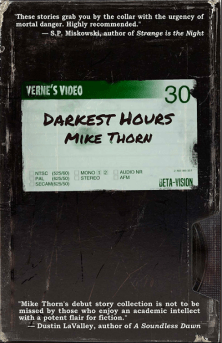
“On top of having this super cool cover, within these pages I discovered some of the best short, dark fiction I’ve read in a long while! Let’s talk about it, shall we?
When I was young and couldn’t afford bookstores, I often went to the library. (I still do, actually, because I love them, not because I have to.) I developed a love of horror back then, but our library’s collection consisted of about two shelves. Once I read those, I started reading all of their anthologies and collections, in the hopes of finding new authors. In this way, I discovered Richard Matheson, Steve Rasnic Tem, Dennis Etchison, Ray Bradbury and other writers that I still love to this day. DARKEST HOURS brought me back to that time of discovery-horror and dark fiction in all of its glorious, different forms. Reading this collection made me feel like a kid again.”

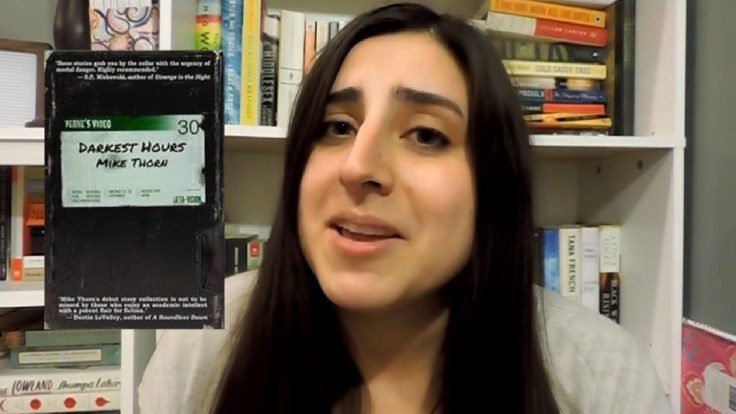
The host of That’s What She Read discussed Darkest Hours in her latest video, with special shout-outs to “Hair” and “Fear and Grace.”


An English major can be a complex and confusing thing. Join Elias, Jaclyn, and Mike on English Major YOU to hear their stories on how to obtain and put an English major to good work. They talk about the important communication and analysis skills that the major will teach, and how those skills can be applied professionally.


Marc Tams laid down psychedelic, shoegazey accompaniment to excerpts from Mike Thorn’s “A New Kind of Drug.” Listen here.
A young man finds himself faced with a bizarre moral dilemma when he agrees to try out a new kind of drug.
Credits
Released June 26, 2018
Narration – Mike Thorn
Score and engineering – Hush
“A New Kind of Drug” features in Mike’s short story collection Darkest Hours, which can be purchased on Amazon here.


Mike Thorn returns to Kendall Reviews with another fascinating discussion piece on horror cinema. The response to Mike’s first contribution which detailed his 10 favourite horror films from the 2010s was incredible. I’m delighted to welcome Mike back, this time to offer you chronologically his favourite horror films released between 2000 – 2009.
Mike Thorn is the author of the short story collection Darkest Hours. He completed his M.A. in English literature at the University of Calgary. His fiction has been published in numerous magazines and anthologies, including Dark Moon Digest, Behind the Mask – Tales from the Id and Straylight Literary Arts Magazine. His film criticism has appeared recently in MUBI Notebook, The Seventh Row and The Film Stage.

 Earlier this year I had a very belated introduction to Marge Simon’s work with Satan’s Sweethearts. Like War (Simon’s newest, co-written with Alessandro Manzetti), Sweethearts (co-authored by Mary Turzillo) is a dense, rigorously researched collaboration in historical horror poetry. Maybe this comparison makes War and Sweethearts sound like extremely particular (even niche) sub-genre pieces, but they benefit equally from clearly defined senses of focus, cohesion and specificity.
War has provided me with another long-delayed introduction, this time to Alessandro Manzetti. Like Simon, Manzetti is an extraordinarily prolific and celebrated force in the contemporary genre field; and like Turzillo’s poetry in Sweethearts, Manzetti’s style in War meshes intuitively and powerfully with Simon’s.
This collection’s title implies a far-reaching, even macrocosmic thematic thread; but Simon and Manzetti wisely choose to lend attention to the tangible, the microcosmic, sometimes even the horrifically banal. Written as a series of free-form pieces (some collaborative, some solo), War is comprised mostly of brutal and uncompromising vignettes and tableaux. Both Simon and Manzetti demonstrate aptitude for calculated and disturbingly descriptive language, making use of poetry’s formal confines to hone exacting depictions of human cruelty.
This focus on the particular does not overshadow War’s considerable ambition: spanning time, place and point of view, this collection approaches its title topic from the terrifying angles of imperialism, post-traumatic stress disorder, misogyny, fear, racism and ignorance. Sometimes slipping into their speakers’ perspectives and sometimes writing with chilling omniscience, Manzetti and Simon offer no reprieves. This book delivers blunt-force impact to match its subject. Fitting for a contemporary world that feels more apocalyptic with every passing day, War demands attention and makes no compromises.

 Stephen King often cites the influence of crime/mystery authors, from brutalist Jim Thompson to classicist Agatha Christie. He has also showcased a career-long interest in the intersections and tensions between genres, often pitting disparate modes against one another (consider the Western/high fantasy/horror fusion of his Dark Tower series). Hell, even his most explicitly horror-specific work is often working within the conventions of “literary” (or non-genre identifying) fiction.
It’s no surprise, then, that his latest novel The Outsider plays out as a police procedural narrative that gradually succumbs to the infection of supernatural horror. The author tried a nearly identical maneuver to less successful effect in 2016’s End of Watch, the final entry in his Bill Hodges trilogy. To that end, his meta-reflective doppelganger riff The Dark Half (1989) showcases another variation on this theme. As such, The Outsider reads not as some unprecedented betrayal of genre-defined rules, but as another iteration of a career-long M.O.—to oversimplify, novels like The Shining (1977) and Pet Sematary (1983) are basically domestic dramas invaded by horror conventions, so why not apply similar principles to the mystery genre?
The Outsider is absorbing as a pure exercise in plotting: King explores his “immovable object against unstoppable force” concept with great aplomb. He writes in his typically minimalist late-career prose style, which lends to compulsive reading but arguably less immersive effect than his early masterpieces (I must admit, I really do miss the intensity and imagery-laden excesses of novels like It [1986], The Tommyknockers [1987] and even Insomnia [1994]). Granted, The Outsider’s debatable lack of total immersion should not be attributed solely to King’s relatively recent change in style. The novel’s generally surface-level and lightly quasi-omniscient characterization is necessitated in part by mystery conventions: the author cannot fully disclose his characters’ deepest secrets and reflections, because (A) it could result in premature plot revelation, and (B) it would be counter-productive to what is essentially plot-driven fiction.
As with Revival (2014), I would have loved to read a longer and more fleshed-out version of The Outsider, allowing for the kind of richly descriptive language and wide-spanning social diagnosis that bolsters King’s best novels. While I ultimately think this is a pretty “minor” book, that’s not so much a slight as it is a tribute to the author’s phenomenal body of work. It’s not without its faults, but it’s engrossing and well-crafted fiction just the same.

I read from my weird academic-in-distress story “Mired” (included in Darkest Hours) for the latest episode of Writer’s Block. Listen to the reading.
Writer’s Block is CJSW’s monthly foray into literature. Hosted and produced by Dymphny Dronyk and sound engineered by Cody Dronyk, the program is focused on local events, writers, poets, publishers, while keeping an eye on the bigger literary picture across the country and around the world! Writer’s Block airs at 90.9 on the FM dial in Calgary on the third Tuesday of every month at 11 a.m. and 8 p.m.

