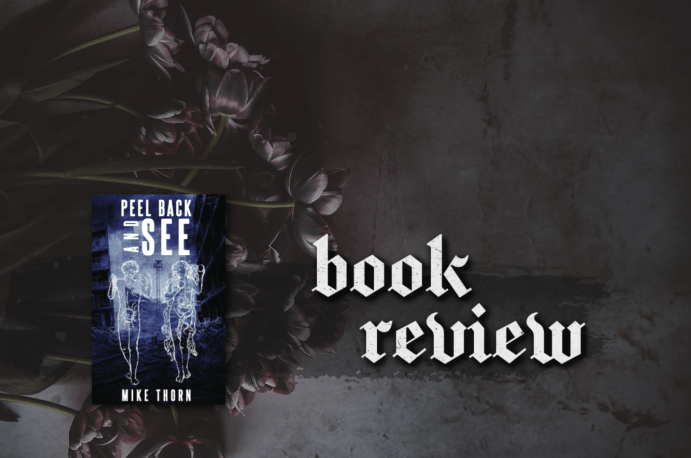
“Mike has a way of paying homage to his influences while creating something incredibly fresh and new, and combining very modern struggles with elements of fear that have plagued humanity for ages.”
Author | Critic

“Mike has a way of paying homage to his influences while creating something incredibly fresh and new, and combining very modern struggles with elements of fear that have plagued humanity for ages.”

Bleedthrough and Other Small Horrors, by Scarlett R. Algee (2020)
The Flowers of Evil, by Charles Baudelaire [edited by Marthiel and Jackson Mathews, multiple editors] (1857)
The Unnamable, by Samuel Beckett (1953)
Selling the Splat Pack: The DVD Revolution and the American Horror Film, by Mark Bernard (2014)
The Brigadier and the Golf Widow, by John Cheever (1964)
On the Heights of Despair, by E. M. Cioran [translated by Ilinca Zarifopol-Johnston] (1933)
The Trouble with Being Born, by E. M. Cioran [translated by Richard Howard] (1973)
Porno Valley, by Philip Elliott (2021)
Less Than Zero, by Bret Easton Ellis (1985)
The Rules of Attraction, by Bret Easton Ellis (1987)
American Psycho, by Bret Easton Ellis (1991)
The Informers, by Bret Easton Ellis (1994)
Glamorama, by Bret Easton Ellis (1998)
Lunar Park, by Bret Easton Ellis (2005)
Imperial Bedrooms, by Bret Easton Ellis (2010)
The Shards, by Bret Easton Ellis (2021)
Carmilla, by J. Sheridan Le Fanu (1872)
The Queer Art of Failure, by J. Jack Halberstam (2011)
In the Presence of Schopenhauer, by Michel Houellebecq [translated by Andrew Brown] (2017)
Humanimus, by David Huebert (2020)
The Damned, by J. K. Huysmans [translated by Terry Hale] (1891)
The Europeans, by Henry James (1878)
Washington Square, by Henry James (1880)
The Bostonians, by Henry James (1886)
Ghost Stories, by Henry James (1898)
Billy Summers, by Stephen King (2021)
The Wingspan of Severed Hands, by Joe Koch (2020)
Straydog, by Kathe Koja (2002)
The Blue Mirror, by Kathe Koja (2004)
Dark Factory, by Kathe Koja (2022; forthcoming)
I’m from Nowhere, by Lindsay Lerman (2019)
Shock!, by Richard Matheson (1961)
The Birds and Other Stories, by Daphne du Maurier (1952)
The Running Trees, by Amber McMillan (2021)
The Seventh Mansion, by Maryse Meijer (2020)
Circles, by Josiah Morgan (2020)
The Barrens, by Joyce Carol Oates (2001)
1984, by George Orwell (1949)
White is for Witching, by Helen Oyeyemi (2009)
The World as Will and Representation, Volume I, by Arthur Schopenhauer [translated by Judith
Norman and Alistair Welchman] (1818)
Wes Craven: Interviews, edited by Shannon Blake Skelton (2019)
Of One Pure Will, by Farah Rose Smith (2019)
The Secret History, by Donna Tartt (1992)
A History of Touch, by Erin Emily Ann Vance (2022; forthcoming)
Miss Lonelyhearts, by Nathanael West (1933)
The Ax, by Donald E. Westlake (1997)


“This juxtaposition between some admittedly cheesy films and their serious thematic undercurrents can be jarring, and nowhere is this effect more evident than in Mike Thorn’s ‘Lizard Brain Ouroboros: Human Antiexceptionalism in Tobe Hooper’s Eaten Alive and Crocodile.’ These films are not the director’s best by a longshot (although the former, his 1976 follow-up to Texas Chain Saw, has enjoyed a cult following), but Thorn skillfully dissects how they illustrate ‘the [triune brain] theory…that human cognition’s roots can be traced to the nonhuman animal world’ (106). The boundary separating these worlds dissolves, and viewers may find themselves rooting more for the so-called ‘monsters’ than the oblivious humans exploiting them.”

“Mike Thorn likes to push his readers’ buttons in surprising ways. I’ve never read two stories by him that were really alike and yet there exists a quintessential Mike Thorn story. Shelter for the Damned is a prime example of his artistry.”


“I could probably sit here and write an essay on why I think Mike Thorn is an author to watch, why I think he takes a great deal of time and effort to make his tales accessible and relatable, and why I think his creative imagination is going to take the world by storm at some point.”



“No surprise here, but when Mike Thorn decides to go dark, it goes dark. It was great to see these stories snap and crack with the energy Mike is known for and we got to revisit a couple oldies, but goodies.”


“A list of favorite books is always more a snapshot of a moment in time than it is some unmoving, monumental thing: if you asked me to assemble this list ten years ago, it would look a lot different, and undoubtedly it will continue shifting as I continue aging and reading and aging and reading.”

 Mike Thorn