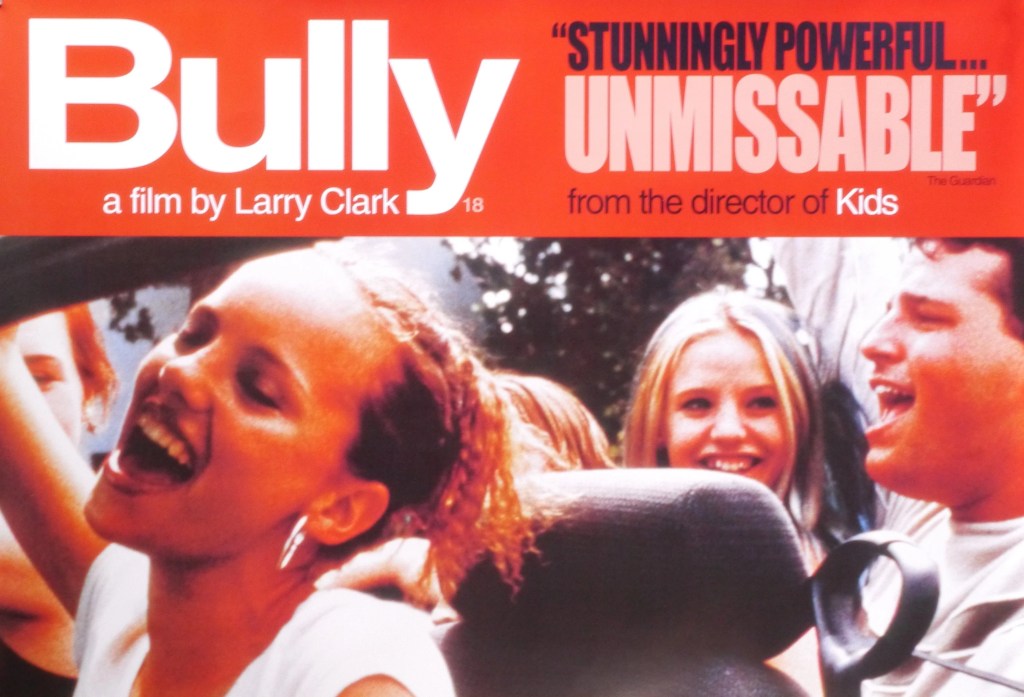
Mike Thorn wrote a long article on Larry Clark’s Bully and Tim Blake Nelson’s O for In Review Online. Subscribe to their Patreon to read the full piece.
Author | Critic

Mike Thorn wrote a long article on Larry Clark’s Bully and Tim Blake Nelson’s O for In Review Online. Subscribe to their Patreon to read the full piece.

Les Vampires (Louis Feuillade, 1915)
The Mystery of the Leaping Fish (Christy Cabanne & John Emerson, 1916)
Hintertreppe (Paul Leni & Leopold Jessner, 1921)
Hell Harbor (Henry King, 1930)
Doctor X (Michael Curtiz, 1932)
The Story of Temple Drake (Stephen Roberts, 1933)
Crime without Passion (Ben Hecht & Lee Garmes & Charles MacArthur, 1934)
Mandalay (Michael Curtiz, 1934)
You Only Live Once (Fritz Lang, 1937)
The Face Behind the Mask (Robert Florey, 1941)
The Sea Wolf (Michael Curtiz, 1941)
Calling Dr. Death (Reginald Le Borg, 1943)
The Curse of the Cat People (Robert Wise & Gunther von Fritsch, 1944)
Weird Woman (Reginald Le Borg, 1944)
The Frozen Ghost (Harold Young, 1945)
Mildred Pierce (Michael Curtiz, 1945)
Shock (Alfred L. Werker, 1946)
Moonrise (Frank Borzage, 1948)
Flamingo Road (Michael Curtiz, 1949)
Stray Dog (Akira Kurosawa, 1949)
The Breaking Point (Michael Curtiz, 1950)
House by the River (Fritz Lang, 1950)
Where the Sidewalk Ends (Otto Preminger, 1950)
Angel Face (Otto Preminger, 1953)
Niagara (Henry Hathaway, 1953)
The Barefoot Contessa (Joseph L. Mankiewicz, 1954)
Killer’s Kiss (Stanley Kubrick, 1955)
Lola Montès (Max Ophüls, 1955)
Bonjour, Tristesse (Otto Preminger, 1958)
Blood and Roses (Roger Vadim, 1960)
Strangers When We Meet (Richard Quine, 1960)
Confessions of an Opium Eater (Albert Zugsmith, 1962)
Diary of a Madman (Reginald Le Borg, 1963)
The Girl Who Knew Too Much (Mario Bava, 1963)
Point Blank (John Boorman, 1967)
Hell in the Pacific (John Boorman, 1968)
One of the Missing (Tony Scott, 1968)
Beneath the Planet of the Apes (Ted Post, 1970)
Loving Memory (Tony Scott, 1970)
Escape from the Planet of the Apes (Don Taylor, 1971)
Conquest of the Planet of the Apes (J. Lee Thompson, 1971)
Pat Garrett and Billy the Kid (Sam Peckinpah, 1973)
Good to See You Again, Alice Cooper (Joe Gannon, 1974)
Lenny (Bob Fosse, 1974)
The Stepford Wives (Bryan Forbes, 1975)
Death Game (Peter S. Traynor, 1977)
Patrick (Richard Franklin, 1978)
Excalibur (John Boorman, 1981)
Roadgames (Richard Franklin, 1981)
Next of Kin (Tony Williams, 1982)
Star 80 (Bob Fosse, 1983)
Scream for Help (Michael Winner, 1984)
The New Kids (Sean S. Cunningham, 1985)
Biotherapy (Akihiro Kashima, 1986)
Guzoo: The Thing Forsaken by God—Part I (Kazuo Komizu, 1986)
Frantic (Roman Polanski, 1988)
Maniac Cop (William Lustig, 1988)
Baby Blood (Alain Robak, 1990)
Flatliners (Joel Schumacher, 1990)
The Guardian (William Friedkin, 1990)
Juice (Ernest R. Dickerson, 1992)
Midori (Hiroshi Harada, 1992)
Menace II Society (Albert Hughes & Allen Hughes, 1993)
Brainscan (John Flynn, 1994)
Species (Roger Donaldson, 1995)
Frat House (Todd Phillips & Andrew Gurland, 1998)
The Phantom of the Opera (Dario Argento, 1998)
Crazy/Beautiful (John Stockwell, 2001)
Freddy Got Fingered (Tom Green, 2001)
Get Over It! (Tommy O’Haver, 2001)
Heartbreakers (David Mirkin, 2001)
Ichi the Killer (Takashi Miike, 2001)
O (Tim Blake Nelson, 2001)
Blue Crush (John Stockwell, 2002)
Bright Future (Kiyoshi Kurosawa, 2002)
Pusher II (Nicolas Winding Refn, 2004)
Pusher 3 (Nicolas Winding Refn, 2006)
Hazard (Sion Sono, 2005)
Apocalypto (Mel Gibson, 2006)
The Grudge 2 (Takashi Shimizu, 2006)
The Shock Labyrinth (Takashi Shimizu, 2009)
The Admiral: Roaring Currents (Kim Han-min, 2014)
Based on a True Story (Roman Polanski, 2017)
Too Old to Die Young (Nicolas Winding Refn, 2019)
All Eyes Off Me (Hadas ben Aroya, 2021)
Limbo (Soi Cheang, 2021)

“If The Way of Water is a crucial work of tech Romanticism, then another of its richest central dissonances is that between past and future: it imagines a world that stands a chance against modernity’s most brutal and oppressive machinations, thus situating itself in the past, but it also uses its genre modality to speculate a future that exceeds postmodernity’s politically flattening failures.”


“The story, in its last third, plunges into dark depths, with touches of cosmic horror and weird , finishing off its construction of adolescent obsessions, parent-child relationships and youth psychology.”

“Mike Thorn updates the psychological horror novel, taking it to cosmic horror and the most stark realism, using a scathing and sometimes excessive style, not suitable for everyone, really raw at times, he has written a brilliant exposition on the truth for urban youth. Like life itself.”